

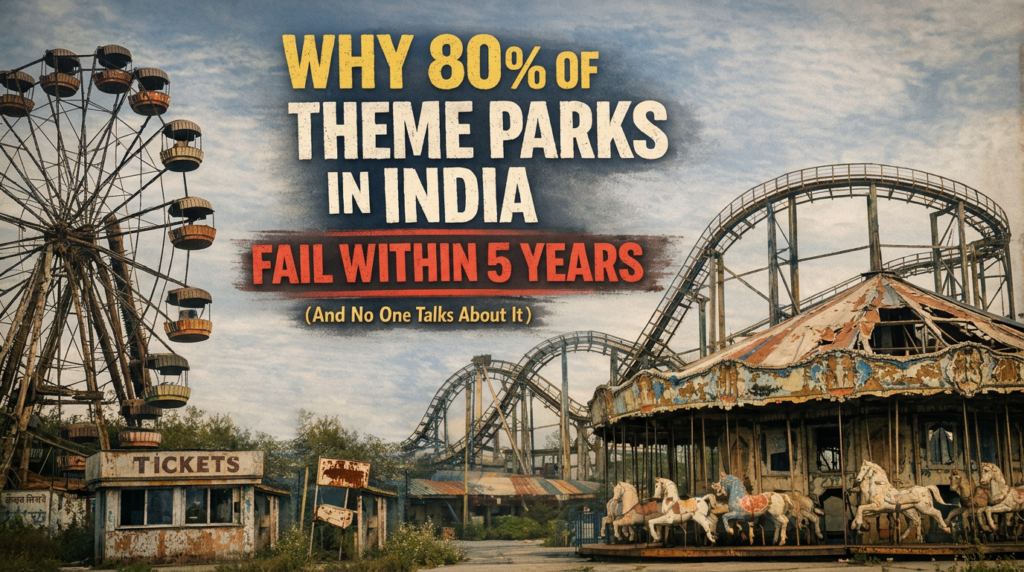
The Statistic Nobody in the Industry Wants to Discuss
Walk through almost any mid-sized Indian city and you will find the ruins of ambition shuttered ticket booths, faded signage, attractions sealed behind rusted gates. India’s entertainment infrastructure is littered with failed parks, and yet the industry keeps adding new ones at the same breathless pace. Something is deeply wrong, and the conversation is long overdue.
The uncomfortable truth is that approximately eight out of every ten theme parks launched in India do not survive their fifth birthday. That is not a pessimistic guess — it is a pattern that repeats itself across states, climates, and demographic segments. And the reasons are almost always the same.
Reason #1 The Feasibility Report Was Either Skipped or Faked
Most failed parks shared one early warning sign: the numbers going into the project looked beautiful on paper and dismal in practice. Developers hired consultants who told them what they wanted to hear, or they skipped the feasibility stage entirely. A credible park design company will always insist on a proper feasibility study before a single rupee goes into ground. That study needs to examine catchment population, disposable income levels, competing attractions, seasonal visitor patterns, and realistic ticket pricing. When that step is rushed or politically shaped, the park is already failing before the gates open.
Reason #2 Location Was Treated as the Only Variable That Mattered
India has seen parks fail in what looked like ideal locations on national highways with high traffic counts, inside wealthy suburbs, adjacent to popular malls. Location matters, but it is far from the whole story. A park built on a strong site with weak experiences, poor operations, and no repeat-visit strategy will burn through its opening curiosity in under six months. Investors who bet everything on footfall from location alone discover too late that footfall and revenue are very different numbers.
Reason #3 Design Was Treated as a Cost, Not an Investment
Professional Theme Park Design Services is the single biggest differentiator between parks that survive and parks that close. Yet the most common budget cut in Indian park development is in design and experience. Developers trim spending on theming, on storytelling, on quality fabrication — and they open with something that looks half-finished, because it is. Visitors sense it immediately. Social media amplifies it. And the word-of-mouth that should build the park’s reputation instead destroys it.
Reason #4 Operations Planning Was an Afterthought
A park is not a building you construct and hand over. It is a living operation that requires daily staffing, maintenance scheduling, revenue management, safety auditing, and seasonal programming. Parks that fail almost universally underestimate operating costs and overestimate the ability to manage those costs without professional systems in place. The result is a gradual degradation — attractions break down and are not fixed quickly, cleanliness slips, staff churn increases, and the visitor experience erodes month by month.
Reason #5 The Market Was Not Educated Properly
India’s entertainment market is maturing rapidly, but visitor expectations vary enormously by region. A park designed for tier-one city visitors will confuse and underwhelm audiences in tier-two markets unless the programming, pricing, and experience design are calibrated accordingly. Successful Theme park development Services always begins with deep market research — understanding not just how many people could visit, but what they want, what they will pay, and how frequently they will return.
Reason #6 Financing Was Structured for Construction, Not Sustainability
Many parks are financed as construction projects with no runway for the operational phase. When the park opens and ticket revenue takes six to twelve months to stabilize — as it almost always does — there is no capital buffer to cover wages, maintenance, and marketing. The park starts cutting corners to survive, which accelerates the very decline it is trying to prevent. Proper park financing should account for eighteen to twenty-four months of operational costs beyond opening day.
Reason #7 There Was No Plan B for Slow Seasons
India’s outdoor entertainment market is violently seasonal in many regions. Summer heat, monsoon rains, and winter school schedules create brutal demand troughs. Parks that do not build seasonal programming, indoor backup experiences, or event-based revenue streams find that their annual average attendance is far below the peak-day numbers they used to justify the investment.
What Successful Parks Do Differently
The parks that survive and eventually thrive in India share a consistent set of practices. They invest in proper Theme Park Consulting Services from the very beginning. They treat design as a revenue driver, not a discretionary expense. They plan for operations with the same rigour they apply to construction. And they build in financial flexibility.
Snomusement Innovations LLP has studied the failure patterns of Indian parks closely, and the consultancy’s framework is specifically designed to close the gaps that cause most parks to fail. From initial feasibility through to operational handover, every decision is stress-tested against real-world market conditions not optimistic projections.
The Silence Is Complicity
The industry’s reluctance to discuss failure openly is itself a problem. When consultants, developers, and investors do not talk honestly about why parks close, the same mistakes keep happening. Developers walk into the market with the same blind spots their predecessors had. Investors lose crores. Communities that were promised entertainment destinations get abandoned lots.
If you are planning an entertainment project, you owe it to yourself to ask hard questions before the ground is broken. Why do so many parks fail? What specific steps are you taking to avoid those failures? And who on your team has the experience to tell you the truth when the optimistic projections do not add up?
Final Thought
India’s entertainment industry has enormous potential. The demographics are right, the aspiration is real, and the demand for quality experiences is growing faster than supply. But that potential will only be captured by developers who are honest about the risks, rigorous in their planning, and willing to invest in the expertise that separates parks that last from parks that become cautionary tales.
The 80% failure rate is not inevitable. It is a choice and every project team gets to make that choice differently.