

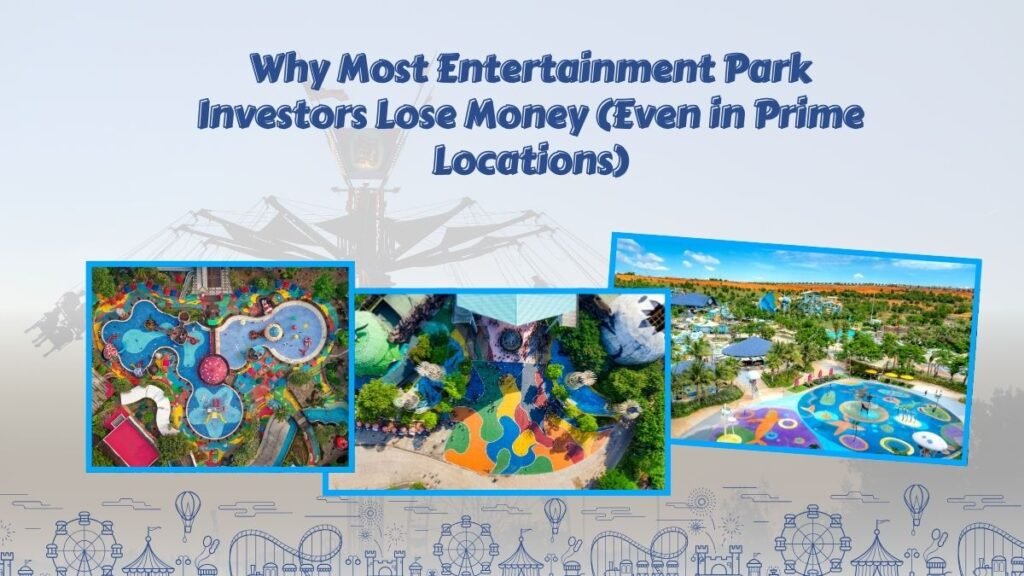
The Prime Location Delusion
It is one of the most expensive misconceptions in Indian entertainment development: that a great location is the primary determinant of a park’s financial success. Investors pay premium land prices for highway-facing sites, for properties adjacent to residential clusters, for positions near major tourist corridors — and then discover that location was necessary but nowhere near sufficient.
The graveyard of failed Indian entertainment parks is full of projects that had excellent locations. What they did not have was everything else.
The Money Trap Starts Before Ground Is Broken
Entertainment park investors typically lose money in one of three phases: before the park opens, in the first operating year, or during the slow-death phase of gradual attendance decline. Understanding which phase is most dangerous for your specific project is the beginning of avoiding it.
Pre-opening losses usually come from budget overruns. The gap between a developer’s initial cost estimate and the actual construction cost of a quality entertainment facility in India is routinely 25 to 40 percent. This gap is almost never the result of dishonest contractors it is almost always the result of an inadequate initial specification. When the project brief is vague, the tender responses are vague, and the inevitable scope clarifications during construction generate change orders that nobody budgeted for.
The Revenue Projection Problem
First-year operating losses are almost always driven by the gap between projected and actual attendance. Entertainment park feasibility studies in India have a consistent bias problem: the attendance projections are too optimistic. They overweight catchment population, underweight competing attractions, and model ramp-up curves that assume faster word-of-mouth than reality produces.
A park that projected 500,000 visitors in year one and achieves 280,000 is not operating in a failed market. It is operating in a normal market, with a budget that was built on an unrealistic projection. The solution is not more aggressive marketing it is more honest feasibility analysis from the beginning, conducted by a team with a track record of accuracy.
The Ancillary Revenue Gap
One of the most reliable indicators of a park’s financial health is the ratio of ancillary revenue to ticket revenue. In well-run parks, food, beverages, merchandise, premium experiences, and events can contribute 40 to 60 percent of total revenue. In poorly designed parks — particularly those that cut investment in F&B infrastructure, retail positioning, and Strategic Space Planning ancillary revenue routinely falls below 20 percent.
The difference between those two scenarios is not marketing spend — it is design quality. A park that is designed to encourage dwell time, to create natural transition points to F&B areas, to position retail where visitors are most receptive, will almost always outperform a park where those elements were treated as afterthoughts.
The Repeat Visitor Trap
Most park business plans model a repeat visitor percentage that is aspirational rather than realistic. The honest truth is that repeat visitation is earned through experience quality, and it compounds over time parks with excellent experiences see their repeat rates grow year over year as they build a loyal local audience. Parks with mediocre experiences see repeat rates decline as the novelty wears off and nothing else drives return visits.
Adventure parks, for example, that invest in regularly refreshed activities and seasonal programming through credible Adventure Park Development Services frameworks tend to maintain repeat rates significantly above the category average. Those that open with a fixed experience and never evolve see attendance decay begin within eighteen months of opening.
Operational Leakage The Silent Killer
Parks lose money in dozens of small ways that individually seem trivial and collectively are devastating. Overstaffing during slow periods. Undermaintained attractions that require emergency repair at peak times. Food waste from poorly managed F&B operations. Energy costs that were never properly modelled. Safety incidents that create liability exposure and damage reputation. Marketing spend directed at broad audiences rather than high-conversion targets.
Each of these leakages is preventable through good operations design. But operations design requires investment — in systems, in training, in expert guidance — and it is routinely the first budget line cut when project costs run over.
What Successful Investors Do Differently
The investors who make money in Indian entertainment parks are distinguished by a handful of consistent behaviours. They engage professional Theme Park Consulting Services before committing capital. They model their financial scenarios conservatively and add contingency for the inevitable cost overruns. They invest in experience quality because they understand that design drives revenue. And they plan for operations from the beginning — not as an afterthought to construction.
Snomusement Innovations LLP works with investors at the earliest stages of project consideration, precisely because the decisions that most determine financial outcomes are made long before construction begins. By the time a park is being built, the trajectory of its success or failure is largely set.
The Event Revenue Blind Spot
One of the most consistently underutilised revenue streams in Indian entertainment parks is events — corporate team-building days, private parties, school group bookings, and sponsored seasonal events. Well-designed parks with the right facilities and programming infrastructure can generate 15 to 25 percent of annual revenue from event bookings that fill capacity during mid-week and off-peak periods when walk-up attendance is thin.
Investors whose financial models ignore event revenue are underestimating the park’s potential. Investors whose facility designs fail to accommodate event formats — private dining areas, bookable zones, backstage access for corporate groups — are leaving money on the table permanently. Event infrastructure should be planned in from the design stage, not retrofitted after opening when the cost and disruption are much higher.
The Uncomfortable Conclusion
Most entertainment park investors who lose money in India are not unlucky. They are the inevitable consequence of optimistic projections, underinvestment in design and planning, and an industry culture that too rarely speaks honestly about the real conditions for success.
Prime locations are a wonderful starting point. They are not a business plan. The investors who understand that distinction are the ones building parks that survive.