

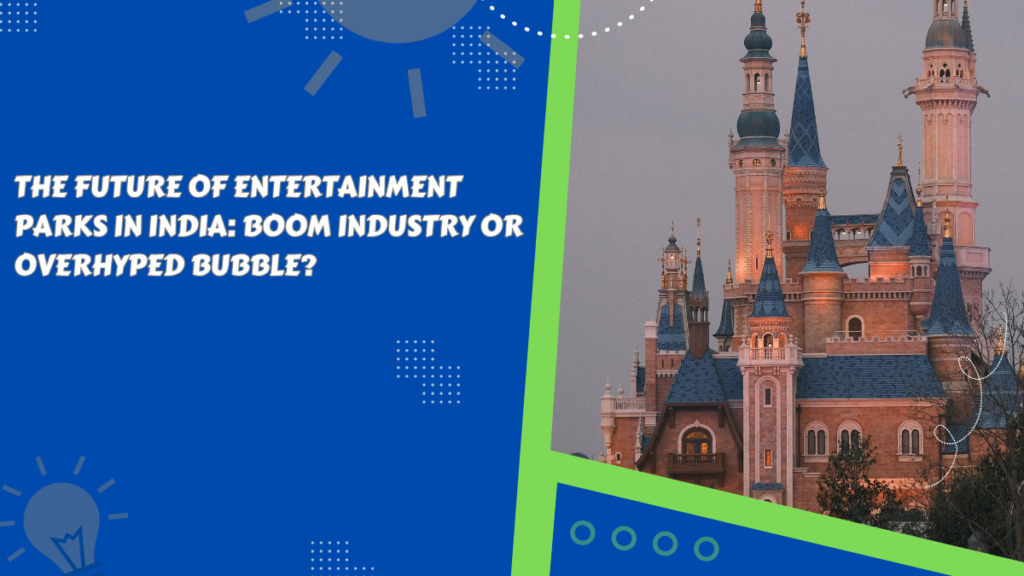
India is changing. Fast. Across its sprawling metros and rapidly urbanizing tier-2 cities, a quiet but powerful shift is reshaping how millions of Indians spend their leisure time. On weekends, families are no longer content with a movie and a mall visit. They want more immersion, more excitement, more memory. And the entertainment park industry is stepping up to meet that demand in ways few could have predicted even five years ago.
But with every boom comes a question: Is this sustainable growth, or are we watching a bubble inflate before our eyes?
The answer, as it turns out, is nuanced and deeply interesting.
India’s Entertainment Economy: The Numbers That Matter
Let’s start with the data. India’s amusement and theme park market was valued at approximately USD 2.5 billion in 2023 and is projected to grow at a compound annual growth rate (CAGR) of over 15% through 2030. This trajectory would put the industry well past USD 6 billion within the decade a figure that rivals established entertainment economies in Southeast Asia.
What’s driving this? A convergence of structural forces that go well beyond disposable income:
1. A Young, Experience-Hungry Population. India has the world’s largest youth population. Over 600 million Indians are under 25. This demographic doesn’t just want products it wants experiences. It documents those experiences on social media. It pays a premium for novelty. The entertainment park industry, at its best, is perfectly positioned to serve this desire.
2. Urbanization at Scale As India’s middle class migrates toward cities not just Delhi and Mumbai, but Raipur, Bhubaneswar, Patna, and Siliguri, demand for entertainment infrastructure is following them. Tier-2 and tier-3 cities are now where the real opportunity lies, with less competition, lower land costs, and a starved appetite for quality leisure destinations.
3. Government Push for Tourism Central and state governments have been actively promoting domestic tourism, investing in infrastructure, and offering incentives for entertainment and hospitality projects. Schemes under the Ministry of Tourism and various state industrial policies have lowered the barrier for private players to build large-format parks.
4. Post-Pandemic Pent-Up Demand The COVID years were devastating for entertainment but they also created an enormous backlog of experiences people craved. When parks reopened, footfall surprised even optimistic operators. That demand hasn’t fully dissipated.
So, Where Is the Industry Headed?
The honest answer is: in multiple directions simultaneously. Let’s break down the key categories shaping the future of Indian entertainment parks.
Theme Parks: Moving Beyond Rides
India’s theme park segment has historically been dominated by basic ride-centric parks that offered thrills but little story. That era is ending. Today’s developers understand that guests remember narrative before they remember machinery. A roller coaster is memorable; a world you step into is transformational.
The emergence of professional Theme Park Design Services has entirely changed the quality conversation. Where earlier parks were designed by civil contractors with aesthetic consultants bolted on as an afterthought, modern developments are conceived through an integrated design process that merges architecture, storytelling, guest psychology, and operational efficiency from day one.
What does this mean practically? It means IP-led theming, climate-controlled zones, digitally interactive attractions, F&B designed as part of the experience rather than a functional afterthought, and layouts that intuitively guide visitor flow. It means parks that don’t just attract a first visit, they earn the second, third, and fourth.
The challenge is investment. A well-designed, full-scale theme park requires significant capital, typically upwards of ₹200-500 crore for a mid-scale development, and several thousand crore for destination parks. This is where Theme Park Consulting Services becomes invaluable. A thorough feasibility study covering catchment analysis, competitive mapping, demand modeling, and financial projections can mean the difference between a project that thrives and one that drains capital within three years of opening.
The Indian market has seen both outcomes. Parks launched without proper due diligence have struggled to maintain footfall past the novelty period. But those built on solid strategic foundations are delivering healthy returns and creating genuine brand equity.
Professional Theme park development Services don’t just build attractions — they build businesses. The distinction is critical.
Snow Parks: India’s Unexpected Success Story
Of all the entertainment formats to boom in tropical India, indoor snow parks were perhaps the least expected. And yet, they have emerged as one of the fastest-growing and most commercially viable segments in the country.
The logic, on reflection, is obvious. For hundreds of millions of Indians, snow is not just rare it is mythical. The idea of walking into a controlled blizzard environment, building a snowman, or sledding down an icy slope in the middle of Raipur or Kolkata is the definition of novelty. It’s experiential escapism at its most vivid.
As a leading Snow Park Design Company, Snomusement has seen firsthand how transformative well-executed snow attractions can be for a city’s leisure landscape. Our delivered projects in Raipur and West Bengal didn’t just attract visitors they became landmarks, talking points, and destinations in their own right. Families drive hours. Schools plan field trips. Corporate groups book out blocks.
But a snow park is not simply a refrigerated room. The engineering complexity is considerable HVAC design that maintains consistent sub-zero temperatures year-round in Indian climates, snow-making systems calibrated for the right texture and depth, thermal insulation that doesn’t compromise architectural aesthetics, and safety systems that protect guests from cold-related risks. The operational demands are equally exacting.
Sustainable, profitable Snow park development Services require end-to-end expertise: from site assessment and energy modeling in the planning phase, through MEP coordination and equipment procurement during construction, to O&M training and retail strategy for ongoing operations. Without this holistic approach, a snow park can quickly become an energy-hungry liability rather than a revenue-generating asset.
The market appetite is clearly there. The question is execution, and that remains the defining variable.
Water Parks: Consolidation and Upgrade
Water parks are India’s most mature entertainment park category, with significant penetration across states. And maturity, inevitably, brings new challenges: rising consumer expectations, tighter safety regulations, and the pressure to differentiate in an increasingly crowded market.
The parks that will survive and grow in this environment are those that invest in experience upgrades, not just adding bigger slides, but reimagining the entire guest journey. This is where a serious Water Park Design Company thinks differently from a rides vendor. It’s about theming zones to create distinct experiential identities, integrating technology for cashless transactions and smart queue management, designing F&B outlets that complement the experience, and building sustainability into operations from the ground up.
Water filtration, in particular, is an area where Indian parks have historically underinvested. In an era of social media, a single health-related complaint can go viral and devastate a season’s bookings. Properly designed water treatment systems are not a luxury — they are existential infrastructure.
The consolidation trend is also worth watching. Smaller, undifferentiated water parks are struggling while larger, better-capitalised operators are acquiring or building premium destinations. This is a healthy rationalisation of the market, and developers who approach the segment with genuine design rigour and operational planning are the ones building lasting businesses.
Adventure Parks: The Active Experience Wave
India’s fitness and outdoor culture is undergoing a generational shift. Younger urban Indians are embracing physical challenges, experiential activities, and outdoor exploration in ways their parents never did. This cultural momentum is the tailwind behind the rapid growth of adventure parks.
From high ropes courses and zip-lines to rock climbing walls and multi-activity outdoor circuits, adventure parks offer a format that is relatively capital-light compared to theme or water parks, while delivering high emotional impact. They are also remarkably versatile viable as standalone destinations, as activity zones within larger parks, or as resort amenities.
A credible Adventure Park Design Company brings more than structural engineering to the table. It brings activity curation — understanding which activities resonate with which demographics, how to sequence the guest journey for maximum excitement and retention, and how to design for operational safety without compromising the thrill factor. Adventure Park Development Services that integrate occupancy estimation and zone planning from day one help developers avoid the classic pitfall of underpricing or under-programming their attraction.
The corporate team-building market has also been a significant, often overlooked, driver for adventure parks. As Indian companies invest more in employee experience, professionally designed adventure parks with group activity infrastructure are well positioned to capture this B2B revenue stream.
FECs and Indoor Play: The Everyday Entertainment Economy
Not every entertainment experience requires a day trip. Family Entertainment Centres FECs occupy a distinct and valuable position in the market: they are the neighbourhood leisure destination, the after-school option, the rainy-day outing, the birthday party venue.
India’s FEC sector is growing rapidly, particularly in malls and mixed-use developments where developers are seeking anchor tenants that drive footfall. But the quality gap remains wide. Too many FECs are glorified arcade rooms with minimal design thought. The opportunity for differentiation through genuine design excellence is enormous.
Creative Indoor Playground Design is at the heart of what makes a great FEC. Children don’t just want to play they want to be transported. A well-designed indoor playground creates an immersive world that stimulates imagination as much as physical activity. The materials, the color palette, the spatial flow, the sensory elements all of it contributes to an experience that parents will remember and return to.
Kids Play Area Design within larger developments malls, hotels, resorts, residential communities is similarly evolving. The generic ball pit surrounded by padded walls is giving way to curated, themed environments that integrate active play, creative exploration, and age-appropriate challenge.
Underpinning all of this is Strategic Space Planning the discipline of making every square foot of a commercial entertainment space work as hard as possible. In Indian real estate markets where commercial rents are significant, an FEC that doesn’t extract maximum value from its footprint is leaving money on the table. Strategic space planning ensures that activity zones, F&B areas, retail touchpoints, entry and exit flows, and back-of-house operations are all optimized in relation to each other.
Glow Gardens and Illuminated Parks: The Instagrammable Frontier
Few entertainment formats have gained traction as rapidly in India as glow gardens and illuminated parks. Part art installation, part entertainment destination, these experiences have been driven almost entirely by social media virality and the developers who understood this dynamic early have been rewarded handsomely.
A skilled Glow Garden Design Company approaches these projects as a convergence of visual art, lighting engineering, and experience choreography. The goal is not just to make things glow it is to create a journey through space and light that feels magical, other-worldly, and deeply shareable. Every installation is a potential Instagram post. Every walkway is a composition. Every light sequence tells a story.
These parks work particularly well as seasonal or temporary activations, allowing developers and operators to keep content fresh and drive repeat visits. They also integrate remarkably well with existing parks or open spaces, offering a lower-cost way to add a premium experience layer.
Museums and Experience Centers: Culture Meets Entertainment
India’s cultural institutions are undergoing a quiet revolution. A new generation of museums, science centers, heritage experience parks, and interactive exhibits is emerging — ones designed not for passive observation but for active engagement. The Museums Design Company of today is as much an experience designer as a curator, integrating digital interactives, immersive environments, and dynamic visitor journeys into what were once static display spaces.
This trend is being driven partly by government investment in cultural infrastructure, and partly by the growing recognition that tourism and education can and should coexist. A well-designed museum or heritage experience center is a compelling destination in its own right, capable of driving significant footfall and economic activity for the surrounding region.
The Bubble Question: Real Risks in a Growing Market
So with all this growth and opportunity, why does the “bubble” question persist?
Because not all investment in this sector is informed investment. The visible success of a handful of well-executed parks has attracted capital from developers with limited understanding of the industry’s unique demands. Entertainment parks are not real estate projects with rides attached. They are operationally complex, experience-driven businesses that require deep expertise in design, engineering, guest psychology, F&B, retail, safety, and marketing all working in concert.
Several specific risks deserve attention:
Catchment Overestimation. Many project promoters overestimate the population within their effective catchment area and underestimate the percentage of that population who will actually visit. Feasibility modelling must be rigorous and conservative, not optimistic.
Underinvestment in Theming and Experience. Parks built on thin design budgets tend to look generic and date quickly. The short-term savings are vastly outweighed by the long-term cost of weak guest loyalty and declining repeat visits.
Operational Unpreparedness. A park can be beautifully designed and still fail operationally. Staffing models, maintenance protocols, safety systems, F&B management, and technology infrastructure all need to be planned and funded from the outset, not improvised after opening.
Undifferentiated Positioning. In markets with multiple competing parks, the absence of a clear, defensible positioning is fatal. Every development needs a compelling answer to the question: why would a guest choose us over the alternative?
The parks that will define India’s entertainment landscape over the next decade are those built by developers who take these risks seriously and partner with expertise that can navigate them. The bubble risk is real but it is concentrated in poorly planned projects, not in the sector as a whole.
The Outlook: Cautious Optimism, Rigorous Execution
India’s entertainment park industry is not a bubble. It is a legitimate structural growth story, underpinned by demographics, urbanisation, rising incomes, and evolving consumer preferences that are not going to reverse. The market opportunity is enormous, and it is still largely untapped, particularly in tier-2 and tier-3 cities where entertainment infrastructure remains decades behind demand.
But capturing that opportunity requires more than capital and enthusiasm. It requires the kind of integrated, expert-led approach that treats an entertainment destination as a holistic business system rather than a collection of attractions. It requires deep feasibility work before a rupee is committed to construction. It requires design that serves the guest experience rather than the developer’s balance sheet. And it requires operational planning that starts on day one, not day three hundred.
Snomusement Innovations LLP was built for exactly this challenge. As a comprehensive park design company, we bring end-to-end expertise across every category of entertainment park development from snow parks and water parks to FECs, glow gardens, museums, and theme parks. Our work spans concept through commissioning, and our commitment extends through the operational phase to ensure that the parks we help build perform as brilliantly in year five as they do on opening day.
The future of entertainment parks in India is bright. But it belongs to those who build it right.
Ready to Build India’s Next Great Entertainment Destination?
Whether you’re evaluating a greenfield entertainment project, upgrading an existing facility, or exploring a new park format for your city, Snomusement’s expert team is ready to guide you from vision to reality.
📞 +91 8013141593 📧 business@snomusement.com 🌐 www.snomusement.com