

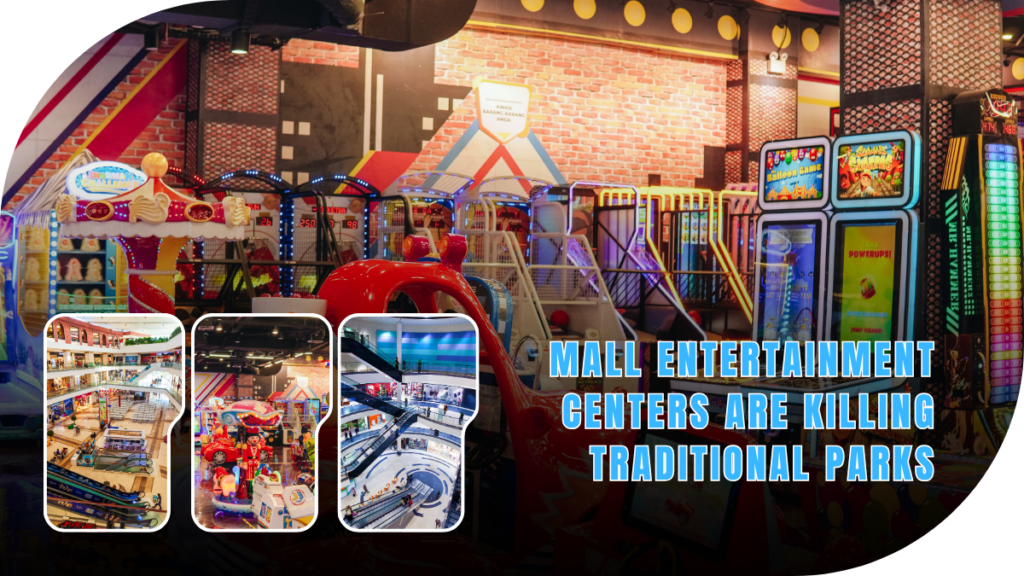
For decades, traditional amusement parks dominated the entertainment industry. Massive outdoor spaces, giant roller coasters, water rides, and seasonal attractions defined what “family entertainment” looked like.
But that model is rapidly changing.
Today, consumers are spending more time and more money inside malls than in standalone amusement parks. Indoor snow parks, trampoline arenas, VR gaming zones, family entertainment centers (FECs), immersive museums, and interactive play areas are becoming the new face of leisure in India and globally.
The uncomfortable truth?
Traditional parks are losing relevance in urban markets.
Mall entertainment centers are not just competing with traditional parks anymore in many cities, they are replacing them.
And if investors, developers, and entertainment brands fail to adapt, they risk building outdated projects in a rapidly evolving industry.
The Rise of Mall-Based Entertainment
Modern malls are no longer designed only for shopping.
They are becoming complete lifestyle ecosystems.
Across India, developers are transforming malls into experience-first destinations where people dine, socialize, work remotely, watch movies, play games, and spend entire weekends indoors.
Entertainment is now the key traffic driver.
According to recent industry reports, malls are increasingly allocating more space to food, leisure, and immersive entertainment experiences instead of relying only on retail stores. (Business Standard)
Why?
Because shopping alone no longer guarantees footfall.
Experiences do.
Why Traditional Parks Are Losing the Battle
Traditional amusement parks still attract large audiences during holidays and peak seasons. But operationally, many are struggling with rising costs, changing customer behavior, and declining repeat visits.
Here’s why mall entertainment centers are gaining an advantage.
1. Consumers Want Convenience
Modern consumers hate long travel times.
Most traditional parks are located on city outskirts because they require huge land parcels. Reaching them often means:
- Long drives
- Traffic congestion
- Full-day planning
- High transportation costs
Mall entertainment centers eliminate that friction.
Families can now enjoy snow parks, VR experiences, trampoline zones, arcade gaming, or indoor attractions while shopping or dining — all in one location.
That convenience changes everything.
Consumers increasingly prefer short-form entertainment experiences that fit into their daily lifestyle rather than dedicating an entire day to a traditional amusement park.
This shift is especially visible in metro cities where time has become more valuable than ever.
2. Indoor Entertainment Works All Year
Traditional parks are heavily affected by:
- Rain
- Heat waves
- Pollution
- Seasonal demand
- Extreme weather
Indoor entertainment centers avoid these problems entirely.
Climate-controlled attractions like snow parks, trampoline parks, VR arenas, and indoor play zones can operate consistently throughout the year.
This gives mall-based entertainment projects a major operational advantage.
In India’s climate, indoor entertainment is becoming increasingly attractive because customers prefer comfortable environments over walking through outdoor parks in extreme heat.
This is one reason why concepts backed by a professional Snomusement style entertainment strategy are focusing more on indoor and hybrid entertainment ecosystems.
3. Mall Entertainment Has Lower Risk
Building a large traditional amusement park requires massive investment.
Developers must spend heavily on:
- Land acquisition
- Infrastructure
- Ride systems
- Utilities
- Staffing
- Safety compliance
- Maintenance
The financial risk is enormous.
Many projects fail because developers underestimate operational costs or overestimate visitor numbers.
Mall entertainment centers operate differently.
Instead of building a 50-acre amusement park, developers can launch smaller entertainment attractions inside existing retail ecosystems.
This dramatically reduces:
- Land costs
- Infrastructure costs
- Marketing expenses
- Utility expenses
Smaller entertainment formats also allow phased investment models, making them more attractive for investors.
4. Today’s Audience Wants Experiences Not Just Rides
The entertainment industry has fundamentally changed.
People no longer visit parks just for rides.
They want:
- Instagrammable environments
- Interactive experiences
- Immersive storytelling
- Social-media-friendly attractions
- Personalized entertainment
This is where indoor entertainment centers excel.
Mall-based attractions can evolve quickly with trends.
They can introduce:
- AR/VR attractions
- Interactive projection mapping
- Escape rooms
- Glow gardens
- Snow experiences
- Digital gaming arenas
- Interactive museums
Traditional parks often struggle to innovate at the same speed because upgrades are expensive and operationally complex.
Consumers today are driven by the “experience economy,” where memorable moments matter more than traditional entertainment formats.
5. Repeat Visits Are Easier for Mall Attractions
Most families visit large amusement parks occasionally.
Maybe once or twice a year.
But mall entertainment centers benefit from repeat footfall because they are integrated into daily urban life.
Visitors might:
- Watch a movie
- Eat at a restaurant
- Shop
- Spend one hour in an entertainment zone
This creates recurring revenue opportunities.
Traditional parks rely heavily on seasonal crowds and destination tourism.
Mall entertainment thrives on regular urban traffic.
That business model is far more sustainable in densely populated cities.
The Explosion of Family Entertainment Centers (FECs)
One of the biggest shifts in the industry is the rise of Family Entertainment Centers.
These are compact, high-engagement entertainment spaces typically located inside malls or mixed-use developments.
Modern FECs include:
- Trampoline parks
- VR gaming
- Bowling
- Arcade systems
- Soft play zones
- Interactive digital attractions
- Indoor adventure courses
Consumers increasingly prefer these active entertainment formats over passive entertainment.
For mall operators, these attractions increase:
- Dwell time
- Footfall
- Food court sales
- Repeat visits
That makes entertainment a strategic asset instead of just an optional addition.
Snow Parks Are Becoming Mall Anchors
One of the most successful indoor entertainment concepts today is the snow park.
India’s hot climate creates strong emotional demand for winter-themed experiences.
Indoor snow parks are now becoming major crowd-pullers inside malls and entertainment complexes.
Why snow parks work:
- Unique experience
- Strong social media appeal
- Family-friendly
- Premium ticket pricing
- Year-round operation
Unlike traditional parks that require massive land areas, snow parks can operate efficiently within mall ecosystems.
This is why many developers are now working with specialized companies offering:
- Snow Park Design Company solutions
- Snow Park Development Services
- Theme Park Consulting Services
- Creative Indoor Playground Design
The future of entertainment is shifting toward compact, immersive, indoor experiences.
Are Traditional Parks Dying Completely?
No.
But they are evolving.
Large destination parks still have strong market potential, especially tourism-driven mega attractions.
However, generic outdoor parks with outdated rides and weak experience design are facing serious pressure.
The market is splitting into two categories:
1. Destination Mega Parks
These survive through:
- Tourism
- Resorts
- Large-scale themed experiences
- Integrated hospitality
2. Urban Indoor Entertainment Ecosystems
These thrive through:
- Convenience
- Repeat visits
- Smaller footprints
- Climate control
- Experience-driven attractions
The middle ground is disappearing.
Parks that fail to evolve risk becoming irrelevant.
The Real Estate Industry Is Driving the Shift
Mall developers have realized something important:
Retail alone is no longer enough.
E-commerce changed shopping behavior permanently.
To survive, malls must become entertainment destinations.
That’s why modern malls are aggressively investing in:
- Entertainment zones
- Interactive attractions
- Gaming experiences
- Indoor theme concepts
- Family entertainment centers
Industry reports show malls across India are redesigning themselves around experience-led retail strategies.
Entertainment is no longer secondary.
It is becoming the core attraction.
Technology Is Accelerating the Decline of Traditional Parks
Technology favors indoor entertainment ecosystems.
Why?
Because indoor attractions can integrate rapidly evolving technologies like:
- VR
- AR
- Motion simulation
- Projection mapping
- Interactive gaming
- AI-powered experiences
Traditional parks often struggle to adopt these technologies due to scale and infrastructure limitations.
Indoor entertainment centers are more agile.
They can reinvent themselves faster.
That agility is critical in modern entertainment markets where trends evolve rapidly.
Consumer Attention Spans Are Shrinking
This is another uncomfortable reality.
Consumers today prefer shorter, high-intensity experiences.
Instead of spending 8–10 hours in a park, many people now prefer:
- 30-minute VR experiences
- 1-hour gaming sessions
- Short interactive attractions
- Social-media-driven activities
Entertainment consumption is becoming fragmented.
Mall entertainment centers align perfectly with that behavior.
Traditional parks were built for longer engagement cycles.
Modern entertainment is shifting toward flexible, shorter-duration experiences.
Why Investors Are Pivoting Toward Indoor Entertainment
Investors are increasingly prioritizing indoor attractions because they offer:
- Faster ROI
- Lower land dependency
- Lower operational risk
- Better urban scalability
- Consistent footfall
- Easier expansion models
That’s why services like:
- Theme Park Development Services
- Adventure Park Development Services
- Kids Play Area Design
- Creative Indoor Playground Design
- Water Park Design Company consulting
- Theme Park Design Services
are evolving toward hybrid indoor-outdoor models instead of relying only on traditional park formats.
The entertainment industry is no longer about building the biggest park.
It’s about building the smartest experience ecosystem.
The Biggest Mistake Developers Still Make
Many investors still believe that “bigger equals better.”
That mindset is dangerous in 2026.
A giant outdoor park with weak engagement can fail faster than a compact indoor attraction with strong repeat visitation.
Today’s successful entertainment projects focus on:
- User psychology
- Strategic space planning
- Experience design
- Social engagement
- Revenue optimization
- Repeatability
This is why professional planning has become critical.
Without expert guidance, many projects risk becoming outdated before they even launch.
What the Future Looks Like
The future of entertainment will likely combine:
- Indoor attractions
- Interactive technology
- Immersive storytelling
- Mixed-use developments
- Retail + entertainment integration
- Climate-controlled experiences
Standalone traditional parks will still exist.
But mall entertainment ecosystems are becoming the dominant force in urban leisure markets.
The winners of the next decade will not necessarily be the companies with the biggest rides.
They’ll be the companies that create the most engaging experiences in the most accessible locations.
Final Thoughts
Mall entertainment centers are not just competing with traditional parks anymore.
They are reshaping the entire entertainment industry.
Consumers want convenience, comfort, immersion, social experiences, and flexible entertainment formats. Mall-based attractions deliver exactly that.
Meanwhile, traditional parks face rising operational costs, weather dependency, massive land requirements, and changing consumer expectations.
This doesn’t mean traditional parks are dead.
But it does mean the old business model is no longer enough.
The future belongs to developers who understand how entertainment, technology, retail, and immersive design now work together as one ecosystem.
And in that future, indoor entertainment is no longer an alternative.