

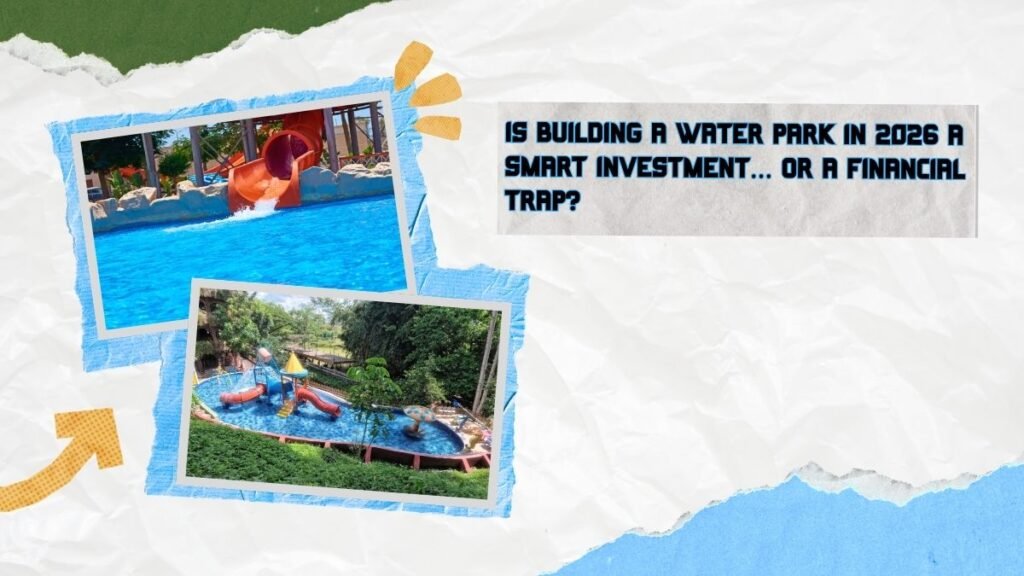
The Question Every Serious Investor Is Asking
Water parks in India have been generating headlines for the past decade some for record attendance numbers, others for spectacular collapses. If you are sitting on capital and considering whether to enter this sector in 2026, you are right to be cautious. The opportunity is real. But so is the risk. Let us go through both sides without the sales pitch.
Why Water Parks Still Make Financial Sense in India
India’s middle class is expanding, disposable incomes are rising in tier-two and tier-three cities, and the demand for family entertainment destinations is structurally strong. Water parks sit at a sweet spot in the entertainment economy they offer high perceived value to visitors, relatively strong ticket yields, and significant ancillary revenue from food, beverages, retail, and events.
The best performing water parks in India today are generating operating margins in the range of 25 to 35 percent once they reach stabilised attendance. That is a strong return profile compared to other real estate and hospitality asset classes. For an investor who is patient, rigorous, and willing to invest properly upfront, the asset class is genuinely attractive.
But Here Is Where Investors Routinely Get Hurt
The failure rate in Indian water parks is not driven by weak market demand. It is driven by poor execution. And poor execution almost always traces back to the same set of decisions made in the first twelve months of a project.
The first trap is underestimating construction costs. Water park infrastructure — pools, filtration systems, slides, pumping equipment, treatment chemicals — is expensive and highly technical. Developers who budget based on square footage rather than per-attraction engineering specifications routinely find themselves 30 to 50 percent over budget before the park opens. A professional Water Park Design Company will give you a capital estimate grounded in real bill-of-quantities, not back-of-envelope arithmetic.
The Operating Cost Trap
Water parks are operationally intensive. They consume large quantities of water, electricity, and chemicals daily. Staffing ratios are high because of safety requirements. Equipment maintenance is non-negotiable a single ride malfunction can result in injury, liability, closure orders, and permanent reputational damage. Investors who model operating costs based on revenues without understanding the cost structure end up trapped in a business that looks profitable on the revenue line and bleeds money on the cost line.
Seasonality Is Real and Must Be Planned For
An outdoor water park in most Indian cities operates comfortably for seven to eight months of the year. The remaining four to five months — typically the monsoon and peak winter period — generate sharply lower attendance. Parks that do not have covered or indoor supplementary attractions, event programming, or corporate booking strategies to fill the off-season find that their annual revenue falls well short of projections.
Smart developers are solving this by designing hybrid facilities outdoor water attractions supplemented by covered entertainment zones, FEC elements, and F&B anchors that generate year-round revenue. This is exactly the kind of Strategic Space Planning that separates profitable parks from loss-making ones.
The Location Fallacy
It is tempting to assume that a water park on a busy highway or near a major urban centre is automatically viable. Location is a necessary condition, not a sufficient one. The park still needs to be designed properly, priced correctly, marketed well, and operated efficiently. There are water parks in excellent locations that are struggling because the design is dated, the experience is mediocre, or the operating team lacks the systems to deliver consistent quality.
What a Smart Water Park Investment Looks Like in 2026
The water park investments that are succeeding today share certain characteristics. They started with a credible feasibility study. They engaged experienced designers and consultants before committing capital. They built in operational flexibility through hybrid facility design. And they modelled their finances conservatively with realistic ramp-up curves rather than day-one optimism.
Snomusement Innovations LLP has been involved in water park planning across multiple Indian markets, and the consistent finding is that the difference between a successful project and a failed one almost always comes down to decisions made in the planning phase, not the construction phase. Getting those early decisions right is worth more than any saving made by cutting corners on design or consultation.
The Technology Investment Nobody Is Budgeting
One of the most underappreciated cost and opportunity drivers in 2026 water park development is technology integration. Cashless payment systems, RFID-based access management, real-time crowd monitoring, dynamic pricing engines, and digital experience overlays — these are no longer optional upgrades. They are infrastructure that directly affects both operating efficiency and visitor experience quality.
Parks that open without this technology layer find themselves retrofitting it at high cost within two to three years. Parks that build it in from the start gain operating efficiencies that improve their unit economics and visitor data that enables smarter revenue management. The investment is real — typically 3 to 5 percent of total project cost for a comprehensive technology layer but the return is measurably positive.
The Verdict for 2026
Water parks in India remain a viable investment category in 2026 but they are not a passive or forgiving asset class. The investors who will make money are the ones who treat this as a serious operating business, not a real estate play with ticket revenue on top. They will invest in proper planning, engage qualified design and development partners, and build in the financial resilience to survive the inevitable early-stage volatility.
The investors who will lose money are the ones chasing quick returns, cutting budgets on design and engineering, and trusting optimistic projections over rigorous analysis. In a market this complex, the difference between those two groups is almost entirely a function of the quality of decision-making in the twelve months before the first shovel enters the ground.
So is building a water park in 2026 smart or a trap? The honest answer is: it depends entirely on how you build it.