

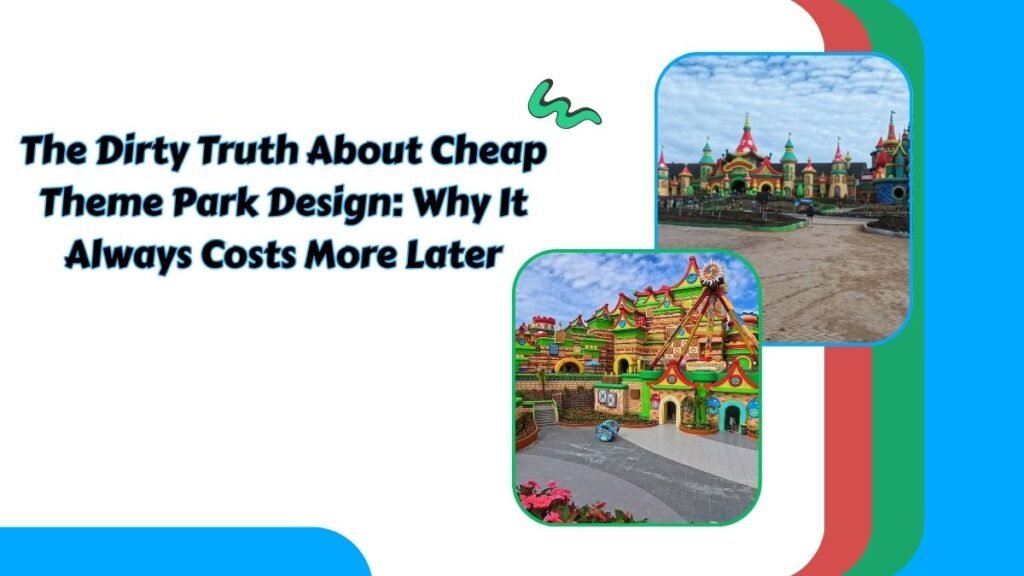
The Budget Cut That Feels Smart and Costs a Fortune
There is a conversation that happens on almost every theme park project in India. The budget review reveals that the project is running over. The team scans the line items for something to cut. Design and theming are usually near the top of the list they look discretionary, they look like aesthetics, and they look like a place to save money without affecting the core infrastructure. So the cuts happen. And the developer congratulates themselves on financial discipline.
Then the park opens. And the real costs begin.
What Cheap Design Actually Produces
Cheap Theme Park Design Services does not just produce parks that look bad it produces parks that perform badly on every operational and financial metric. Here is what actually happens when design investment is slashed:
Visitor dwell time collapses. A well-designed park creates an environment that encourages exploration, discovery, and spontaneous spending. A poorly designed park — with unclear wayfinding, uninspiring zones, and no experiential progression pushes visitors toward the exit. When dwell time drops, so does per-capita spending on food, beverages, merchandise, and add-on experiences. The revenue loss from a two-hour reduction in average visit length can easily exceed the entire design budget that was saved.
Repeat visitation rates crater. One of the critical metrics in theme park economics is the percentage of visitors who return within twelve months. In well-designed parks with immersive environments and strong theming, repeat rates can reach 40 to 60 percent. In parks where the experience feels cheap or incomplete, repeat rates often fall below 15 percent. A park that cannot generate repeat visits is permanently dependent on new visitor acquisition — which is expensive, and ultimately impossible to sustain.
The Structural Costs of Getting Design Wrong
Beyond the revenue impact, cheap design creates a series of structural problems that are expensive to fix after the fact. Poor visitor flow design creates bottlenecks and crowd management issues that require costly staffing solutions. Inadequate shade and comfort infrastructure leads to premature departures on hot days. Weak food and beverage positioning reduces ancillary revenue. All of these problems can be solved through retrofit and renovation but the cost of fixing a poorly designed park after it opens is typically three to five times what it would have cost to design it correctly in the first place.
The Social Media Problem
A decade ago, a mediocre park could survive on marketing spend and low local competition. In 2026, that is no longer true. Every visitor carries a high-resolution camera and access to platforms that reward sharp, visually striking content. A beautifully designed park generates organic content that functions as free marketing. A poorly designed park generates exactly the opposite — mocking photos, disappointed reviews, and viral comparisons to better parks in other cities. The reputational damage from a bad opening is now permanent and searchable.
The Renovation Trap
Parks that cut design budgets and open with substandard experiences typically follow a predictable path. Attendance is disappointing in year one. Management identifies design deficiencies as the cause. A renovation budget is approved. But renovation is always harder and more expensive than original build because the park must remain partially operational during the work, and because retrofit solutions are almost never as elegant as original design. The park ends up spending more than it would have spent on good design in the first place — and it loses revenue during the renovation period on top.
Snomusement Innovations LLP has been called in to provide remediation consulting on parks that opened with inadequate design investment. The pattern is remarkably consistent: the savings made at the design stage were recovered within the first year of operations — not as profit, but as additional costs to fix what should have been right from the start.
What Proper Theme Park Design Investment Actually Buys
When developers invest properly in Theme park development Services, they are buying several things simultaneously. They are buying visitor experience quality, which drives dwell time, per-capita spending, and repeat visitation. They are buying operational efficiency, because good design eliminates the expensive workarounds that poor design requires. They are buying social media performance, because a well-themed environment generates shareable content. And they are buying flexibility, because a park built on strong design foundations can evolve and expand without structural reinvention.
The Right Way to Think About Design Costs
Design costs in a theme park project should not be evaluated as a percentage of construction budget. They should be evaluated as a percentage of projected lifetime revenue. When you model the revenue impact of higher dwell times, stronger repeat rates, better ancillary spending, and superior social media performance, the return on quality design investment is almost always strongly positive — often in excess of ten to one over a ten-year operating period.
The park that saved money on design and the park that invested in design will look roughly similar on a construction budget spreadsheet. They will look nothing alike on a five-year revenue and profitability comparison.
The Honest Conclusion
There is no such thing as cheap theme park design that works. There is only cheap design that fails visibly from day one, and cheap design that fails slowly over the first three years as repeat rates collapse and renovation costs mount. The question is not whether to invest in quality design it is when you want to pay for it. Upfront, when it creates value. Or retrospectively, when it repairs damage.
The developers who understand this distinction are the ones building parks that survive. The ones who do not are providing case studies for every future generation of consultants explaining why the failure rate is so high.