

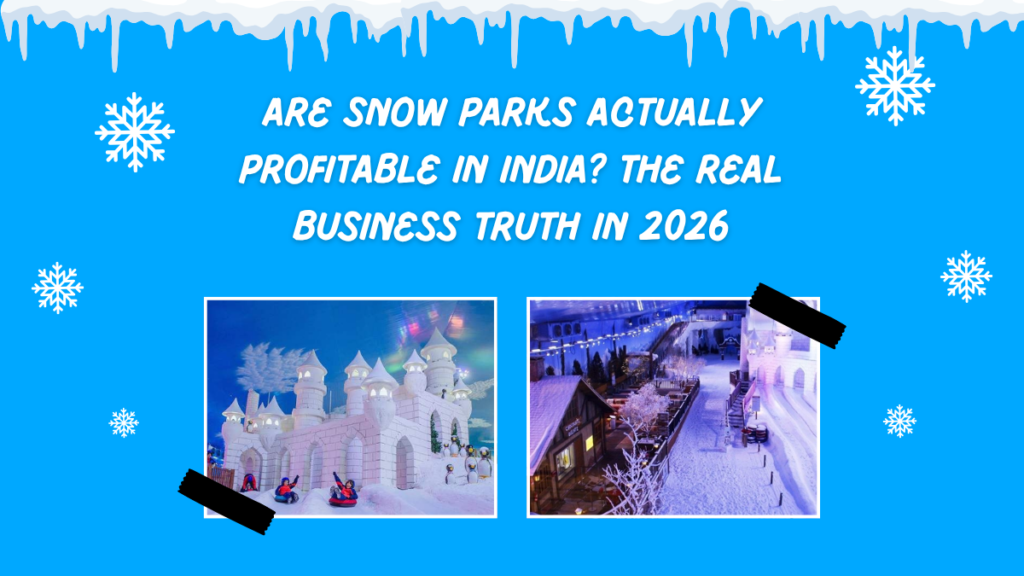
India is known for scorching summers, crowded malls, and a rapidly growing middle class. Now imagine bringing snowfall, ice slides, and winter experiences into cities where temperatures touch 40°C. Sounds unusual, right?
Yet that’s exactly why indoor snow parks are becoming one of the most talked-about entertainment businesses in India.
From metro cities to tier-2 markets, snow parks are attracting families, teenagers, tourists, and mall visitors looking for something unique. But behind the Instagram-worthy snow photos and long weekend queues lies a serious business question:
Are snow parks actually profitable in India or are they just expensive hype?
The answer is not as simple as “yes” or “no.”
Some snow parks generate strong revenues and become major crowd-pullers. Others struggle under high electricity bills, poor planning, weak locations, and unrealistic expectations.
So let’s break down the real economics, opportunities, risks, and future of the snow park industry in India.
The Rise of Indoor Snow Entertainment in India
India’s entertainment industry is shifting rapidly toward experiential attractions. Traditional parks are no longer the only option. Consumers today want:
- Immersive environments
- Climate-controlled attractions
- Instagrammable experiences
- Family-friendly indoor entertainment
- Activities inside malls and urban spaces
This is one reason India’s indoor amusement industry has expanded rapidly in recent years. Reports from ANAROCK and IAAPI estimate the indoor amusement sector at around ₹15,000 crore, with consumer spending increasing significantly after the pandemic.
This trend strongly benefits snow parks because they combine:
- Novelty
- Visual appeal
- Family entertainment
- Indoor comfort
- Premium ticket pricing
Unlike traditional parks that depend heavily on weather conditions, snow parks can operate year-round.
Why Snow Parks Attract Indian Consumers
India is a tropical country. Most people rarely experience real snowfall unless they travel to places like Manali, Gulmarg, or Kashmir.
Indoor snow parks solve that emotional gap.
They allow visitors to experience:
- Artificial snowfall
- Snowball fights
- Ice slides
- Snow tubing
- Winter-themed environments
- Frozen selfie zones
The psychological appeal is powerful.
For many families, especially in metro cities, snow parks feel like a “mini foreign experience” without expensive travel.
That emotional factor matters more than many investors realize.
People are not only paying for rides.
They are paying for:
- Escapism
- Social media content
- Family outings
- Climate relief
- Unique memories
That is why snow parks often outperform generic entertainment centers in terms of visitor curiosity and repeat footfall.
So… Are Snow Parks Profitable?
Yes — snow parks can be highly profitable in India.
But profitability depends heavily on five critical factors:
- Location
- Technical planning
- Footfall consistency
- Operational efficiency
- Revenue diversification
A properly designed snow park in a high-footfall urban location can become a strong cash-flow business.
A poorly planned one can become an electricity-burning disaster.
That’s the reality.
Understanding the Revenue Model
Most people think snow parks only earn from ticket sales.
That’s incorrect.
Successful snow parks generate revenue from multiple streams.
1. Entry Tickets
This is the primary income source.
Snow park tickets in India are usually priced at premium levels because the experience feels unique and operational costs are high.
Visitors are often willing to pay more for:
- Real snow environments
- Temperature-controlled experiences
- Special winter activities
Premium pricing works especially well in malls and urban entertainment hubs.
2. Food & Beverage
Cold environments naturally increase food and beverage spending.
Visitors frequently purchase:
- Hot chocolate
- Coffee
- Snacks
- Fast food
- Combo meals
F&B margins in entertainment businesses are often extremely profitable.
3. Photography & Video Services
People love taking photos inside snow environments because they look visually different from everyday Indian surroundings.
Professional photography services can generate surprisingly strong additional revenue.
Many parks also monetize:
- Instant photo printing
- Branded souvenirs
- Video recordings
- Social media content booths
4. Merchandise & Winter Wear
Snow jackets, gloves, caps, socks, and souvenirs create additional monetization opportunities.
Some parks rent winter clothing separately.
Others include it in premium packages.
Either way, ancillary sales help improve margins.
5. Birthday Parties & Group Events
This is where many entertainment businesses become truly profitable.
Schools, birthday celebrations, corporate outings, and private bookings create higher-value transactions than regular ticket sales.
Interestingly, discussions around indoor entertainment businesses frequently mention events and parties as major profit drivers rather than only daily visitors.
Why Some Snow Parks Succeed
Not every snow park succeeds.
But the successful ones usually have certain things in common.
1. They Choose the Right Location
Location is everything.
The best-performing snow parks are usually located inside:
- Large malls
- Tourist hubs
- High-density urban areas
- Entertainment clusters
A snow park hidden in a low-footfall location will struggle no matter how beautiful it looks.
Many investors underestimate how important daily walk-in traffic is.
Snow parks thrive on impulse visits.
Families shopping in malls often decide spontaneously to enter a snow attraction.
That spontaneous footfall is critical.
2. They Focus on Experience, Not Just Snow
A room filled with ice is not enough.
Modern audiences want immersive experiences.
The most successful parks include:
- Interactive zones
- Lighting effects
- Snow rides
- Music integration
- Themed environments
- Social-media-friendly design
People remember experiences — not temperature settings.
3. They Understand Operational Efficiency
This is the hidden side of the business.
Snow parks consume substantial energy.
Cooling systems, snow generation equipment, insulation, dehumidification systems, and maintenance all require serious operational planning.
Poor technical execution can destroy profitability.
High electricity costs are one of the biggest challenges in India’s climate conditions.
Even public discussions around snow parks often mention energy consumption and maintenance complexity as major concerns.
This is why professional engineering and specialized entertainment infrastructure planning matter so much.
Why Some Snow Parks Fail
Now let’s talk about the uncomfortable reality.
Many snow parks fail because investors treat them like ordinary entertainment projects.
They are not ordinary.
They are technically complex businesses.
Here are the most common reasons for failure.
1. Poor Financial Planning
Snow parks require significant upfront investment.
Common expenses include:
- Refrigeration systems
- Insulation
- Snow machinery
- HVAC systems
- Specialized flooring
- Interior theming
- Technical maintenance
If investors underestimate operational costs, the project quickly becomes financially stressful.
2. Wrong Audience Targeting
A luxury snow experience may work in metro malls but fail in smaller markets with lower spending capacity.
Understanding local demographics is essential.
Premium entertainment only works when purchasing power supports it.
3. Lack of Repeat Value
The novelty factor alone is not enough.
Visitors may come once for photos but never return if:
- Activities are limited
- Experience feels repetitive
- Ride quality is weak
- Maintenance declines
Repeat visits are critical for long-term profitability.
4. Weak Marketing
Many entertainment businesses underestimate digital marketing.
Today’s consumers discover attractions through:
- Instagram reels
- YouTube shorts
- Influencer videos
- Google searches
- Social sharing
Snow parks are highly visual businesses.
That visual nature should be aggressively leveraged online.
Is the Demand Sustainable?
This is probably the biggest investor concern.
Is the snow park trend temporary?
Or is it a long-term business category?
Current market indicators suggest that indoor experiential entertainment is continuing to grow in India.
Industry reports show:
- Rising leisure spending
- Strong growth in indoor amusement centers
- Higher post-pandemic consumer spending
- Increasing demand for experiential attractions
Additionally, India already has one of the world’s largest numbers of indoor snow entertainment centers outside China, and several operators are expanding aggressively.
That suggests confidence in long-term demand.
Snow Parks vs Traditional Amusement Parks
One major advantage snow parks have is scalability.
Traditional outdoor amusement parks require:
- Massive land
- Large ride infrastructure
- Weather dependency
- Huge maintenance teams
Snow parks can operate in comparatively smaller indoor spaces.
This makes them attractive for:
- Mall integration
- Urban projects
- Tier-2 expansion
- Mixed-use developments
However, they also come with higher technical operating complexity.
So while the space requirement is smaller, the engineering challenge is greater.
Are Tier-2 Cities Ready for Snow Parks?
Surprisingly, yes — in many cases.
Tier-2 cities are rapidly embracing experiential entertainment.
Consumers in smaller cities increasingly seek:
- Modern leisure activities
- Mall-based attractions
- Family entertainment destinations
- Social-media-worthy experiences
But success in tier-2 cities depends heavily on:
- Pricing strategy
- Mall partnerships
- Population density
- Local spending behavior
Not every city can support a premium snow attraction.
Feasibility studies become extremely important here.
The Biggest Hidden Cost Nobody Talks About
Electricity.
This is the single most important profitability factor in snow park operations.
Running refrigeration systems in India’s climate is expensive.
Without:
- Proper insulation
- Energy-efficient systems
- Technical optimization
- Smart operational management
…the business can become difficult to sustain.
This is why many experienced operators focus heavily on technical infrastructure rather than just attractive interiors.
Good engineering directly affects profitability.
The Role of Professional Snow Park Planning
This is where many investors make critical mistakes.
They hire general contractors instead of specialized entertainment consultants.
Snow parks require expertise in:
- Visitor psychology
- Technical engineering
- Crowd flow
- HVAC integration
- Safety systems
- Experience design
- Revenue optimization
Professional planning significantly reduces costly operational mistakes later.
That’s why experienced Theme Park Consulting Services and Snow Park Design Company expertise often become essential for long-term project success.
What the Future Looks Like
The future of snow parks in India looks promising — but competitive.
Over the next few years, the industry will likely shift toward:
- Larger immersive attractions
- Hybrid entertainment zones
- AI-driven interactive experiences
- Mall-integrated snow environments
- Premium family entertainment destinations
Simple “ice rooms” will probably struggle.
Experience-rich attractions will dominate.
Consumers are becoming more sophisticated.
They want entertainment worth sharing online and worth revisiting physically.
Final Verdict: Are Snow Parks Actually Profitable in India?
Yes — snow parks can absolutely be profitable in India.
But they are not easy-money businesses.
The projects that succeed usually combine:
- Strong locations
- Smart engineering
- Great visitor experience
- Aggressive digital marketing
- Multiple revenue streams
- Professional planning
The projects that fail usually suffer from:
- Poor feasibility analysis
- Weak operations
- High energy inefficiency
- Generic design
- Lack of differentiation
India’s growing appetite for experiential entertainment creates massive potential for snow parks. Industry growth data, rising consumer spending, and expanding indoor amusement demand all point toward strong long-term opportunities.
But profitability is never automatic.
In the entertainment industry, concept alone is not enough.
Execution is everything.