

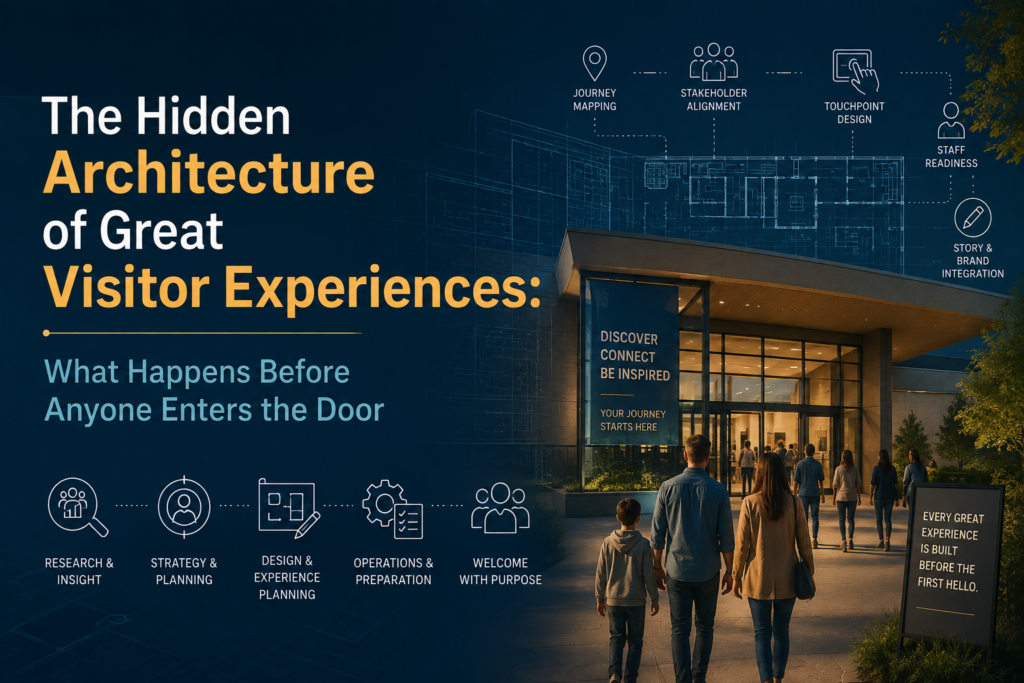
Every great visitor experience has a backstory. Behind the excitement, the sensory richness, and the memories that guests carry home lies months sometimes years of deliberate, methodical planning. And surprisingly, some of the most important decisions happen before anyone has even seen the inside of the venue.
What colour is the entrance? How does the exterior communicate the experience inside? What does the visitor see, hear, and feel as they approach? These are not decorative questions. They are foundational ones that determine whether a venue captures attention or fades into the background.
The Pre-Entry Experience
Experience designers refer to the sequence of impressions a visitor receives before entering a venue as the “pre-entry experience.” This includes the visibility of the building from the road, the quality of approach pathways, the character of the facade, the landscaping, the signage, and even the sounds and smells of the surroundings.
Get this sequence right, and visitors arrive already excited, already primed for what awaits them inside. Get it wrong, and you spend the rest of the visit trying to recover from a disappointing first impression.
Facade Design as Emotional Storytelling
The facade of an entertainment or commercial destination is far more than protective cladding. It is the opening chapter of the story you are telling your visitors. A well-conceived facade design communicates themes, sets emotional expectations, and creates a sense of arrival.
This is why leading venues invest in working with a specialist Facade Design Company rather than delegating this work to a general contractor. The difference in outcome is not subtle it is the difference between a building that tourists photograph and share versus one that people struggle to remember.
Inside the Experience: Why Dedicated Centers Matter
Once visitors cross the threshold, the quality of the immersive environment becomes paramount. This is particularly true for branded, educational, or highly thematic destinations — where every element of the interior must work together to reinforce the core experience.
This is the domain of an Experience Center Development Company specialists who design and build environments where architecture, technology, content, and human behaviour are integrated into a single, seamless encounter. These are not simply decorated rooms. They are engineered experiences where lighting, sound, spatial flow, interactive elements, and narrative arc are all precisely calibrated.
Elevation: The Visual Identity of Your Property
In architectural terms, elevation refers to the external face of a building as seen from the ground. For commercial properties and entertainment destinations, elevation design is one of the most powerful branding tools available — yet it is consistently undervalued.
Professional Commercial Elevation Design Services take a holistic approach: considering the building’s relationship to its street context, the quality of materials, the play of light at different times of day, and the way the elevation communicates the identity of the business within.
The Integrated Approach
The venues that deliver the most memorable visitor experiences are those where exterior and interior design, landscape, facade, and experience engineering are planned together from the start. Fragmented design processes produce fragmented results. Integrated processes produce destinations.
If you are planning a visitor destination of any kind — entertainment, retail, hospitality, or cultural the most important investment you can make at the outset is in a team that understands this integration. Every decision made in isolation will cost you more to fix later.