

For decades, the blueprint for building a successful entertainment project followed a highly predictable path. If an investor wanted to launch a major theme park, a large water park, or a high-end indoor family entertainment center, they would focus entirely on Tier-1 megacities. Metros like Mumbai, Delhi, Bangalore, and Bangalore were seen as the only regions with enough population density and disposable income to support large-scale entertainment infrastructure.
However, a massive shift is occurring across the economic landscape. Tier-1 markets have become intensely saturated. High land acquisition costs, skyrocketing labor expenses, fierce competition for consumer attention, and squeezed profit margins have made new large-scale developments in major metros financially risky.
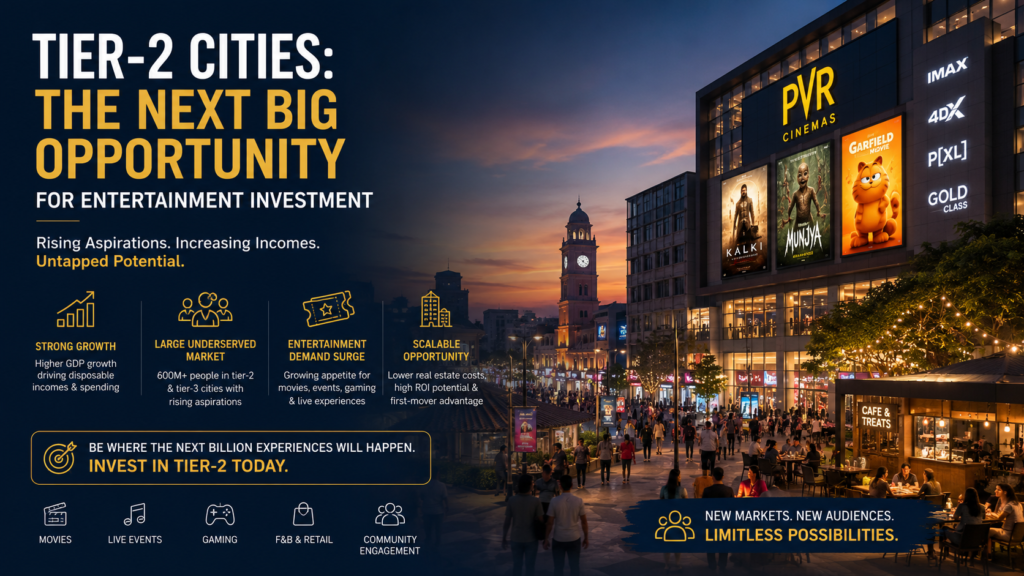
Meanwhile, the real growth engine has shifted elsewhere. Tier-2 cities such as Jaipur, Lucknow, Surat, Coimbatore, Nagpur, and Bhubaneswar are experiencing an economic boom. Driven by rapid infrastructure growth, the rise of remote and hybrid corporate work, and the growth of local industries, these secondary cities are seeing a historic rise in middle-class wealth.
Despite this economic growth, these booming cities suffer from a massive “entertainment deficit.” The people living in these regions have the money to spend, but they lack high-quality local options for family leisure, weekend activities, and experiential entertainment. For forward-thinking real estate developers and commercial investors, Tier-2 cities represent the single greatest untapped opportunity for high-yield entertainment investments.
1. The Entertainment Deficit: High Demand Meets Low Supply
The most compelling reason to invest in Tier-2 cities is the sheer imbalance between local demand and available supply. Historically, families living in smaller cities had to travel to a major metro area or a vacation destination to experience a world-class amusement park, a premium indoor play zone, or a high-tech gaming center.
Today, that expectation has completely changed. Consumers in secondary cities are highly connected through digital media and global travel. They want the exact same lifestyle options, retail brands, and premium leisure experiences available in megacities. This desire for equal lifestyle options creates an immediate customer base for the very first premium attraction that opens in the region.
- Underutilized Consumer Capital: Families in these cities have fewer avenues for discretionary spending. While a household in a Tier-1 city splits its entertainment budget across dozens of competing options (concerts, fine dining, multiple mega-malls, and theaters), a family in a Tier-2 city will naturally flock to a singular high-quality venue, creating reliable, concentrated weekly footfall.
- The Power of Community and Word of Mouth: In smaller urban markets, a premium new attraction quickly becomes a major local landmark. Word travels fast, local pride drives organic marketing, and the venue becomes the default destination for school field trips, corporate outings, and large family celebrations.
2. The Economic Advantages: Lower Costs, Faster Profitability
From a pure business perspective, the financial math behind building an entertainment project in a Tier-2 city is incredibly favorable for an investor’s balance sheet. When launching a project, the two largest financial challenges are initial Capital Expenditure (CAPEX) and ongoing Operational Expenditure (OPEX). Secondary cities significantly reduce pressure on both metrics.
- Cheaper Real Estate: Land is the single greatest cost barrier in modern entertainment development. In Tier-2 cities, commercial land or mall square footage is available at a fraction of the cost seen in prime metro zones. This allows investors to buy larger plots of land, providing plenty of space for expansive layouts, guest parking, and future attraction expansions without breaking the budget.
- Reduced Operational Costs: Ongoing overhead costs, including local labor, municipal utility rates, property taxes, and regional marketing, are significantly lower in secondary markets. Lower fixed operating costs mean your business has a much lower break-even point, paving a faster, safer path to full profitability.
- Longer Customer Retention: Because residents in smaller cities have shorter daily commutes and lower daily stress levels than metro commuters, they approach weekend leisure with a much more relaxed mindset. Visitors stay at venues longer, thereby boosting food, beverage, and retail spend per visit.
3. Spatial Engineering: Designing the Perfect Tier-2 Layout
To capture this growing market successfully, developers cannot simply copy a metro blueprint and drop it into a smaller city. The local audience requires a tailored approach to layout, sizing, and community integration. This is why successful investors collaborate with a professional park design company to implement Strategic Space Planning from day one.
The physical layout must reflect local family structures and social habits. In Tier-2 markets, family outings are highly multi-generational. Grandparents, parents, aunts, uncles, and children regularly travel together as a cohesive social unit.
- Multi-Generational Zoning: The floor plan must be structurally engineered to accommodate large family groups simultaneously. This means a venue must seamlessly balance high-energy active zones with comfortable, quiet hospitality areas where adults can socialize while maintaining clear lines of sight to the play areas.
- Focus on Early Childhood Development: A highly profitable approach to securing long-term local loyalty is creating dedicated, high-quality spaces for younger children. By integrating specialized Kids Play Area Design and Creative Indoor Playground Design, an entertainment center becomes an essential weekday resource for young parents, driving consistent morning and afternoon footfall when older schoolchildren are in class.
- Maximizing Event Spaces: Smaller cities often lack premium, air-conditioned venues for private celebrations, corporate events, and large children’s birthday parties. Dedicating a significant portion of the floor plan to versatile, high-capacity banquet and party rooms allows the business to secure reliable, high-margin group bookings months in advance.
4. The Entertainment Anchor: Revitalizing Regional Retail
The rise of e-commerce has forced commercial real estate developers to completely reimagine the traditional shopping mall. In the past, department stores and fashion brands served as the primary “anchors” that drew crowds into shopping centers. Today, consumers buy clothes online, meaning retail alone cannot sustain a massive property.
In Tier-2 cities, where new mega-malls are being built at a rapid pace, entertainment has become the new anchor. Developers are realizing that instead of filling a vacant floor with more empty shops, installing a massive family entertainment center, an indoor theme park, or a unique adventure zone is the absolute best way to drive consistent regional traffic.
When a mall includes a major entertainment attraction, it creates a powerful economic ecosystem. Families arrive for the attraction, but stay to shop at retail stores, dine at the food court, and watch movies at the cinema, dramatically increasing the property value of the entire real estate asset.
5. Diversifying the Portfolio: Specialized Attraction Formats That Win
Because competition is still relatively low in secondary cities, investors have the rare opportunity to monopolize the local market by introducing unique, highly specialized entertainment formats. Rather than building a generic arcade room, deploying high-concept attraction verticals creates an insurmountable competitive advantage.
- Climatic Novelty: In regions that experience intense summer heat or monsoon seasons, bringing an indoor winter experience to the city creates an incredible marketing buzz. Partnering with a specialized Snow Park Design Company to execute advanced Snow park development Services allows developers to offer indoor ice sliding, snow playing, and real sub-zero temperatures. The extreme contrast between the local weather and an indoor winter landscape drives massive, recurring ticket sales.
- Active and Youth Sports Entertainment: To capture teenagers, young adults, and fitness enthusiasts, working with an established Adventure Park Design Company is highly effective. By utilizing professional Adventure Park Development Services, operators can install safe, indoor high-altitude rope courses, zip lines, and large trampoline parks that challenge physical capability and appeal to the growing local youth culture.
- Aquatic Destinations: For larger, outdoor suburban plots, collaborating with an experienced Water Park Design Company allows investors to construct regional water parks featuring massive wave pools, family raft rides, and lazy rivers. A well-engineered water destination can easily draw crowds from neighboring towns and villages, extending your market reach far beyond the city limits.
- Cultural and Evening Attractions: Evening and night-time revenue can be captured by working with a leading Glow Garden Design Company to build beautiful, illuminated walkthrough trails that activate after sunset. Similarly, partnering with a professional Museums Design Company enables the creation of high-value, interactive edutainment spaces that attract school groups, tourists, and educational tour groups.
6. Navigating the Market: The Importance of Expert Guidance
While the opportunities in Tier-2 cities are massive, executing a project in a developing market requires precision, local regulatory awareness, and deep industry knowledge. An investor cannot rely on generic templates or guesswork. If a project is built with poor equipment, unsafe layouts, or inaccurate financial modeling, it will quickly fail.
To protect capital and ensure long-term operational success, smart developers bring in comprehensive Theme Park Consulting Services early in the planning stages. Expert consultants perform deep regional feasibility studies, analyzing local income brackets, spending habits, power availability, and supply chain logistics.
By combining these market insights with world-class Theme Park Design Services and structured Theme park development Services, developers can ensure that their venue is structurally optimized, tailored to the exact scale of the local economy, and engineered to deliver sustained financial returns for decades.
Partner with Snomusement to Capitalize on the Tier-2 Boom
The economic transformation of Tier-2 cities offers a golden opportunity for investment in entertainment infrastructure. The markets are wide open, land is accessible, and the consumer demand for world-class entertainment has never been higher.If you are an investor, real estate developer, or hospitality group looking to establish a dominant, highly profitable entertainment landmark in a booming secondary market, Snomusement is your trusted B2B partner. We operate as India’s premier entertainment infrastructure consultancy, specializing in turning market data and bold imaginations into highly secure, high-ROI commercial realities.