

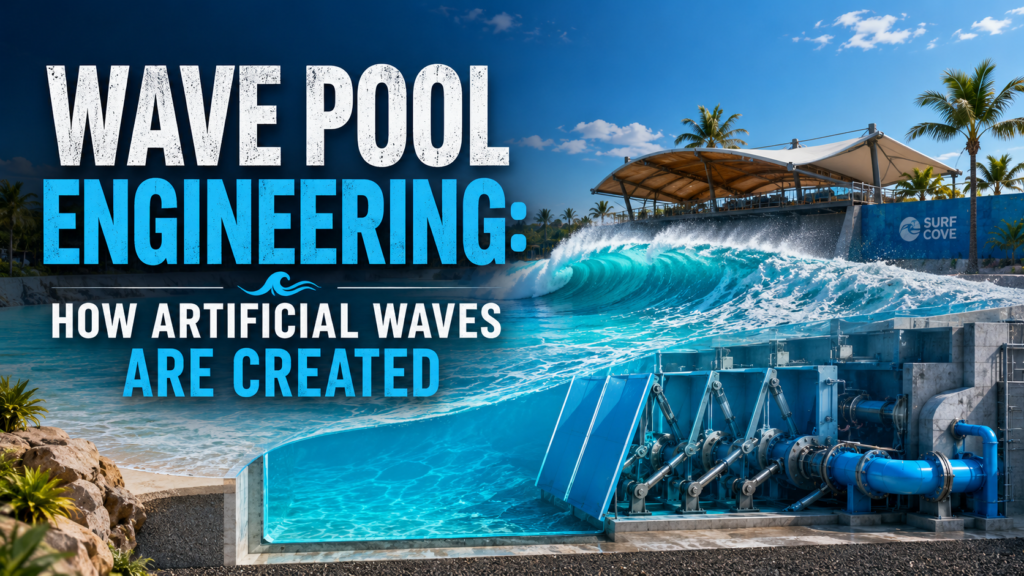
Wave pools are the undisputed centrepieces of modern water parks. They act as massive crowd magnets, offering the rhythmic, rolling energy of the ocean inside a completely controlled environment. For real estate developers, hospitality groups, and investors, a wave pool is not just a large swimming pool; it is a highly sophisticated feat of hydraulic, pneumatic, and structural engineering.
To the average visitor, the waves look like magic. But behind that shifting water lies a complex system of heavy machinery, computer-guided valves, and precise fluid dynamics. Understanding how these massive systems operate is essential for anyone looking to invest in modern commercial entertainment infrastructure.
The Core Physics: How a Wave is Born
Before looking at the machines that build waves, it helps to understand what a wave actually is. A wave is not water moving across the pool; it is energy moving through the water.
In the open ocean, wind transfers its energy to the sea’s surface, creating swells. In an artificial pool, an engineering system must mimic this wind by displacing a massive volume of water in a precise, repeating rhythm. When you push water in one specific spot, you create a disturbance. That energy travels outward in the form of a wave crest (the peak) and a wave trough (the low point).
To make this happen consistently, a professional park design company relies on three primary types of engineering systems:
- Pneumatic Systems (Air-Powered)
- Hydraulic Systems (Water-Powered)
- Mechanical Systems (Moving Paddles)
1. Pneumatic Wave Generation: The Power of Air
Pneumatic systems are the most popular choice for standard, family-focused commercial water parks. If you have ever floated in a large theme park wave pool, you were likely riding pneumatic waves.
How the Technology Works
Pneumatic systems use air pressure to displace water. At the deep end of the pool, engineers build a series of large, submerged concrete chambers. These are called wave chambers.
- The Air Blowers: Massive, high-velocity industrial fans (blowers) sit in a dry mechanical room behind the pool. These blowers generate an enormous volume of pressurized air.
- The Valve Cycle: Computerized control valves sit atop the concrete chambers. When the system turns on, the valves open to blast pressurized air directly down into the chambers.
- Water Displacement: This sudden burst of air lowers the water level inside the chamber. Because the water has to go somewhere, it escapes through an opening at the bottom of the chamber and rushes out into the main pool, creating a wave.
- The Exhaust Phase: The computer instantly switches the valve, venting the air out of the chamber. This creates a vacuum, drawing water back into the chamber.
By cycling these valves open and closed in milliseconds, engineers can create different wave patterns, from gentle, parallel rolling swells to crisscrossing diamond waves.
2. Hydraulic Systems: The Power of Gravity
Hydraulic wave pools, often called “dump tank” systems, operate on a completely different engineering principle. Instead of using air to push water, they use gravity and water volume.
How the Technology Works
Hydraulic systems are less about continuous rhythm and more about sudden, massive impact. They are frequently used in parks seeking to generate large, solitary tsunami-like waves.
- The Elevated Reservoirs: Engineers construct massive water tanks high above the deep end of the pool. High-capacity, industrial-strength pumps continuously draw water from the main pool and fill these upper reservoirs.
- The Drop: When the tanks are full, large underwater release gates at the bottom of the reservoirs snap open simultaneously.
- Gravitational Force: Thousands of gallons of water drop instantly into the deep end of the pool. The sheer weight and force of this falling water displace the pool water ahead of it, sending a single, powerful wall of water toward the beach.
While hydraulic systems create incredibly powerful waves, they require significant energy to constantly pump water back up into the high tanks between cycles, making them a specialized choice for specific guest experiences.
3. Mechanical Systems: The Power of Physical Displacement
Mechanical systems use solid, physical objects to push water forward. While less common in massive family water parks today due to the wear and tear on underwater moving parts, they are highly relevant in specialized surf lagoons.
How the Technology Works
- Piston and Paddle Systems: In these configurations, large metal or fiberglass panels are submerged at the back of the pool. Massive hydraulic arms push these panels back and forth like giant oars.
- The Foil Method: The latest evolution in high-end surfing parks involves an underwater hydrofoil, essentially an airplane wing turned sideways. A mechanical track pulls this foil along the center or side of a massive lagoon. As the foil slices through the water, it generates a perfectly shaped, continuous wave behind it, ideal for professional surfing.
The Crucial Role of Pool Floor Topography
A wave machine is only half of the engineering equation. The shape, slope, and depth of the concrete pool shell itself play an equally critical role in how a wave behaves. This is a primary focus during Theme Park Design Services.
When a wave leaves the mechanical chambers at the deep end, it travels through deep water smoothly because the energy has plenty of room to move beneath the surface. As the wave travels toward the shallow end, the pool floor slopes upward. This upward slope forces the water column to shallow outa process fluid dynamicists call shoaling.
- Slowing Down the Bottom: As the water gets shallower, the wave’s bottom experiences friction with the concrete floor, slowing it.
- Cresting the Top: The top of the wave, unaffected by the floor friction, continues moving forward at full speed.
- The Break: Eventually, the top of the wave outruns the bottom, becomes unstable, and tumbles forward, creating a safe, white-water breaking wave that washes onto the artificial beach.
If the floor slope is too steep, the wave will slam down violently, creating a safety hazard. If the slope is too gradual, the wave will simply fizzle out without breaking. Precision engineering ensures the angle is perfect.
Behind-the-Scenes Infrastructure: Water Filtration and Load Dynamics
Building a wave pool requires massive investments in foundational infrastructure that guests never see. When launching a project, utilizing expert Theme Park Consulting Services helps developers navigate these heavy industrial requirements.
- Massive Structural Loads: A wave pool holds millions of gallons of water. When that water is set in motion, it generates immense kinetic force against the concrete walls and floor. Engineers must reinforce the pool shell with heavy-duty structural steel to prevent cracking and shifting over time.
- High-Rate Filtration Systems: Because wave pools hold huge crowds, the water turnover rate must be exceptionally fast. Specialized commercial filtration systems must completely clean, treat, and recirculate the entire pool volume every few hours to maintain strict health and safety standards.
- Acoustic Engineering: Industrial air blowers and hydraulic pumps generate significant noise. Mechanical rooms must be structurally insulated and located away from guest areas to prevent mechanical sounds from disrupting the park’s tropical, relaxing atmosphere.
Holistic Layout: Integrating Multiple Zones into Modern Entertainment Hubs
A wave pool cannot exist in isolation. For a destination to achieve high profitability, developers must take a big-picture approach through Strategic Space Planning. This involves mapping out visitor traffic flow, seating, food stalls, and surrounding attractions.
Today’s real estate trends show that developers rarely build standalone water zones. Instead, they integrate them into mixed-use mega-resorts and multi-climate indoor entertainment centers. This is where cross-disciplinary design becomes vital. A developer might collaborate with a specialized Water Park Design Company to build the outdoor aquatic zone, while simultaneously working with a Snow Park Design Company to build an adjacent indoor winter attraction.
Managing these massive, multi-zoned developments requires an understanding of how distinct entertainment concepts complement one another on a single property:
- Year-Round Revenue Stability: Coupling an outdoor water park with indoor attractions ensures consistent foot traffic regardless of seasonal weather. Through professional Snow park development Services, developers can create a sub-zero indoor environment right next to a warm outdoor resort.
- Diverse Family Appeal: A mega-destination can balance high-thrill zones designed by an Adventure Park Design Company with dedicated, low-impact spaces. Integrating professional Kids Play Area Design and a Creative Indoor Playground Design ensures that families with toddlers stay just as long as families with teenagers.
- Immersive Night-Time Attractions: To maximize evening revenue, developers often build experiential walkthroughs nearby. Partnering with a Glow Garden Design Company allows the property to transition into an illuminated wonderland after dark, while working with a Museums Design Company provides high-value educational indoor exhibits for daytime learning.
- Scale and Scope Execution: By leveraging comprehensive Theme park development Services and expert Adventure Park Development Services, master planners can seamlessly connect water filtration lines, structural foundations, and power grids across completely different attraction zones, saving millions in long-term operational costs.
Partner with Snomusement for Expert Entertainment Infrastructure
Engineering a world-class wave pool or master-planning a multi-zoned entertainment destination requires specialized industrial knowledge, strict safety compliance, and proven commercial expertise.
If you are an investor, property developer, or hospitality group looking to build a high-ROI destination, Snomusement is your strategic B2B partner. We operate as a premier entertainment infrastructure consultancy and development brand, turning complex engineering concepts into highly profitable business realities.
Our team provides end-to-end consulting, technical design, and development oversight across all specialized entertainment sectors, including:
- Advanced master planning and Theme Park Design Services.
- Technical engineering and layout solutions from a leading Water Park Design Company.
- Sub-zero mechanical engineering led by a trusted Snow Park Design Company providing comprehensive Snow park development Services.
- High-thrill, structurally sound concepts from an established Adventure Park Design Company offering full Adventure Park Development Services.
- Vibrant, high-occupancy family zones utilising specialised Kids Play Area Design and Creative Indoor Playground Design.
- High-margin, immersive evening concepts developed by a professional Glow Garden Design Company.
- Experiential edutainment layouts curated by an expert Museums Design Company.
We eliminate the guesswork from high-ticket entertainment investments by delivering deep technical authority, rigorous safety engineering, and data-backed feasibility metrics.
Contact Snomusement today to schedule a professional project feasibility and engineering consultation.