

For decades, amusement industry operators treated safety briefings as a necessary evil. They were viewed as cold, legal requirements, dry checklists read aloud by a tired ride operator or printed on warning signs that guests actively ignored. The general assumption was that safety rules put a damper on fun, slowing down the transition from the queue line to the actual attraction.
Today, top-tier global entertainment brands look at safety through a completely different lens. Modern operational data proves that the safety briefing is not a barrier to the guest experience; it is an essential pillar of it.
When an entertainment destination designs its safety protocols correctly, it does not pull the guest out of the fantasy world. Instead, it deepens their immersion, lowers their anxiety, and actively builds anticipation for the attraction ahead. For project developers and investors, transforming safety from a legal chore into an experiential asset is a critical step toward building a world-class venue.
1. The Psychology of Safety: Why Secure Guests Have More Fun
To understand why safety briefings must be integrated into the guest experience, we have to look at how the human brain processes thrill and adventure. Amusement rides and extreme attractions are designed to trigger a controlled biological fear response, releasing adrenaline and endorphins that create the feeling of excitement.
However, there is a major psychological difference between “fun fear” and “real terror.”
- Fun Fear: The guest knows, deep down, that they are perfectly safe. This allows the brain to process the drops, twists, and speed as pure joy and entertainment.
- Real Terror: The guest genuinely doubts the mechanical integrity of the ride or feels confused about what they are supposed to do. This triggers a survival response, leading to extreme panic, dissatisfaction, and an immediate desire to leave.
When a professional park design company maps out a high-thrill attraction, they use the safety briefing to establish psychological safety before the physical experience ever begins. A clear, authoritative, and engaging briefing acts as an emotional anchor. By clearly communicating how the equipment works, what safety redundancies are in place, and exactly what the guest needs to do, the venue removes negative anxiety.
Once the guest’s brain feels completely secure about their survival, they are fully open to enjoying the simulated danger of the ride. In short, confident guests have more fun, stay longer, and leave better reviews.
2. The “Pre-Show” Revolution: Turning Rules into Storytelling
How do you get thousands of daily visitors to pay close attention to critical safety instructions without boring them? The answer lies in integrating theatrical narrative, commonly known as the “pre-show.”
Instead of breaking character right before a ride starts, advanced Theme Park Design Services weave safety guidelines into the attraction’s storyline. This method hides the dry rules inside the entertainment fabric of the experience.
Consider how a modern immersive ride handles this transition:
- Contextual Setting: Instead of a standard concrete waiting room, guests enter a themed staging area, perhaps a high-tech laboratory, an ancient temple chamber, or a command center.
- Character Delivery: Rather than an employee reading from a card, a digital character, an animatronic, or a themed video host delivers the instructions. For example, a “flight commander” might explain how to secure your seatbelt before you blast off into an asteroid field.
- Environmental Cues: Synchronized lighting effects, sound design, and video screens highlight safety bars, lap restraints, and exit paths during the fictional mission briefing.
By framing safety instructions as a critical mission briefing or a training session for an upcoming adventure, the park accomplishes two things at once. First, it ensures 100% compliance because the guests are highly focused on the media display. Second, it uses the safety briefing time to build intense anticipation, making the wait time feel shorter and much more engaging. This seamless narrative blend is a hallmark of premium Theme park development Services.
3. Active Attractions: Managing Risk Through Shared Responsibility
The role of a safety briefing shifts dramatically when moving from passive rides (like roller coasters, where the machine does all the work) to active, participatory attractions. In venues featuring high-action challenges, guests must physically execute movements to stay safe.
When an Adventure Park Design Company builds high-altitude obstacle courses, ziplines, or climbing walls, the safety briefing becomes an active, hands-on instructional seminar. In these environments, the briefing serves several functional purposes:
- Equipment Familiarization: Guests learn how to interact with tactile components like smart-locking carabiners, continuous-belay safety tracks, and full-body harnesses.
- Physical Demarcation: Operators use live demonstrations or interactive video guides to show guests proper body posturing, braking techniques, and landing procedures.
- Assessment of Capability: An active briefing allows staff to observe guest behavior, ensuring that individuals fully understand the physical requirements of the course before they ascend to dangerous heights.
By investing heavily in the quality and clarity of these interactive briefings during Adventure Park Development Services, operators create a culture of shared responsibility. Guests leave the briefing room feeling empowered, capable, and highly aware of their surroundings, which dramatically reduces the rate of operational incidents.
4. Architectural Flow: Designing the Space for Safety
An engaging safety briefing cannot happen in a crowded, noisy hallway. It requires a physical space specifically engineered to facilitate learning, focus, and smooth crowd movement. This is where Strategic Space Planning becomes an absolute necessity for project developers.
The layout of a high-capacity attraction must treat the safety briefing zone as a structural transition chamber between the general queue and the ride loading platform.
- Batching and Capacity Control: The briefing room must be designed to accommodate the exact number of guests who can fit on a single ride cycle or ride vehicle. This allows operators to split a massive, chaotic line into small, manageable groups.
- Acoustic Isolation: The walls and ceilings of the briefing room must use specialized sound-deadening materials. By blocking out the loud screams and mechanical noise of the active ride area, developers create a quiet zone where guests can easily hear and understand every word of the safety instructions.
- Visual Focusing Agents: The architectural design should naturally direct all eyes to a central focal point, whether a presentation stage or a high-definition video array. This structural layout eliminates distractions and maximizes information retention.
5. Tailoring Safety Packages Across Diverse Attraction Zones
Modern commercial entertainment properties are rarely uniform; they often feature multiple distinct microclimates and play formats within a single footprint. A developer must recognize that a safety briefing strategy that works for a high-speed coaster will completely fail in an indoor playground or a historical gallery.
To maintain high experiential standards, operators must deploy customized communication styles across every unique zone within their master plan:
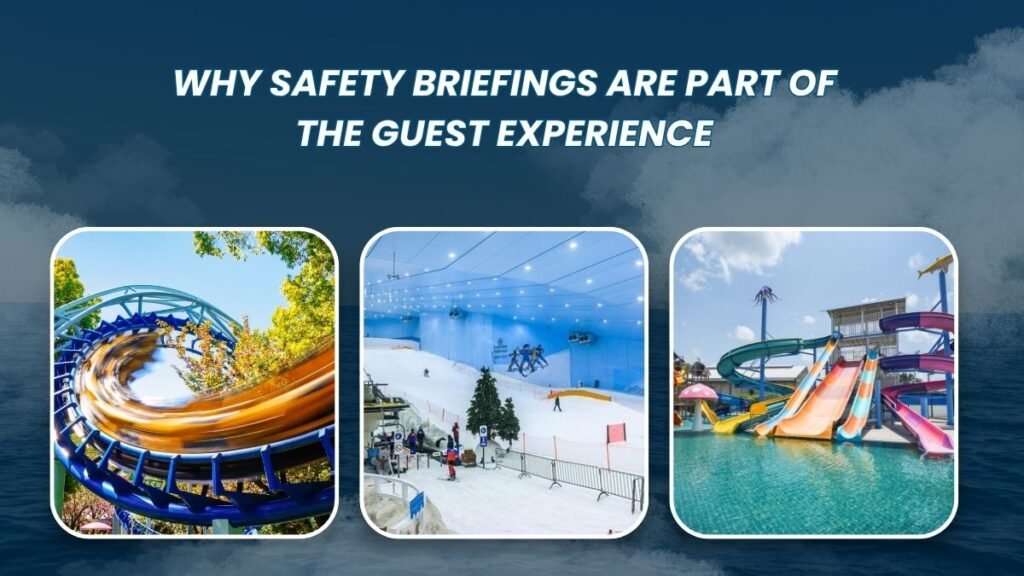
- Aquatic Environments: In deep-water wave pools or high-velocity waterslides, safety communication must be instantaneous and highly visible. A professional Water Park Design Company installs highly visible, color-coded graphic signage and utilizes automated audio alerts at slide entry points to ensure swimmers understand depth variations and body positions before entering the water.
- Sub-Zero Attractions: Indoor winter environments require specialized operational care. When working with a Snow Park Design Company to execute Snow park development Services, safety briefings focus heavily on thermal protection, slip hazards on real ice, and proper footwear compliance to prevent cold-exposure injuries.
- Vibrant Family Play Spaces: For younger children, traditional briefings are ineffective. Creative layouts incorporating Kids Play Area Design and Creative Indoor Playground Design shift the safety briefing burden onto the parents. The space is laid out with comfortable seating zones that give adults clear lines of sight, while the safety rules are displayed with playful, friendly characters that children can easily understand.
- Cultural and Educational Galleries: In quieter indoor spaces built by a specialized Museums Design Company, safety briefings are subtly integrated into digital orientation kiosks or audio guides. The focus shifts to protecting delicate exhibits and guiding crowd flow smoothly through narrow walkways without disrupting the building’s contemplative mood.
Secure Your Project’s Success with Snomusement
Designing, engineering, and executing a world-class entertainment destination requires a sophisticated balance of creative storytelling, structural space planning, and absolute compliance with safety standards. If you leave safety mechanics as an afterthought, you risk damaging your brand reputation, lowering visitor satisfaction, and facing severe liability issues.If you are an investor, real estate developer, or commercial property owner looking to build a highly secure, profitable, and memorable destination, Snomusement is your trusted B2B partner. We operate as a premier entertainment infrastructure consultancy, offering world-class master planning, rigorous technical execution, and comprehensive Theme Park Consulting Services.