

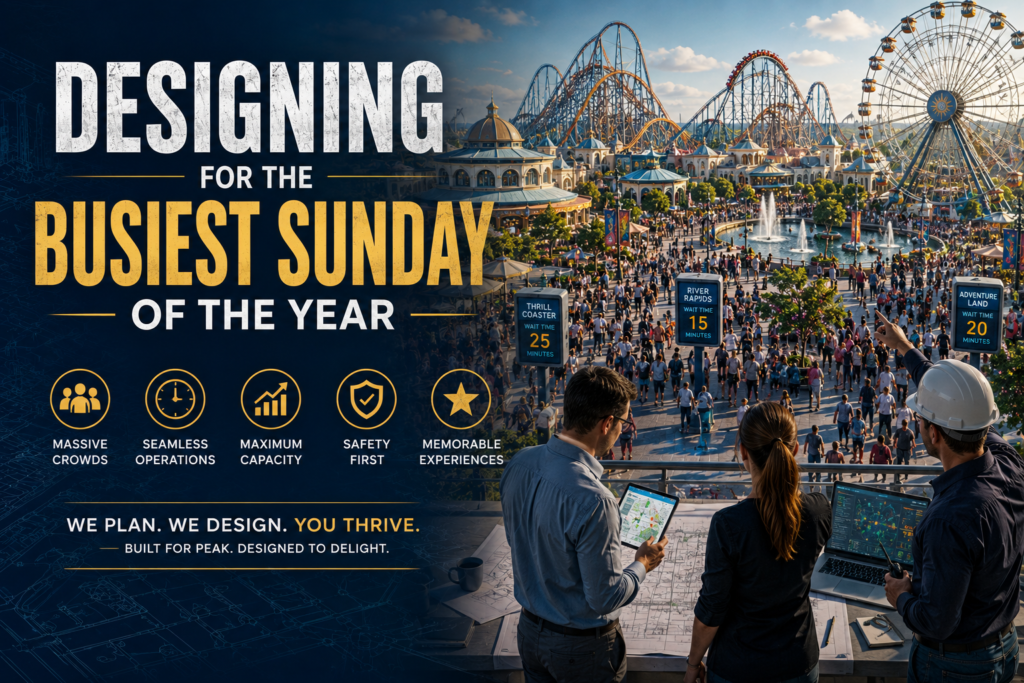
Anyone can design an attraction that feels wonderful on a quiet Tuesday morning with two hundred guests. The real test arrives on the first Sunday of summer vacation, when four thousand people walk through the gates within three hours every one of them wet, excited, and in a hurry to get to the biggest slide.
A water park lives or dies by how it behaves at peak load. Experienced designers do not plan for the average day; they plan for the day when everything is stretched to its limit. Here is what that means in practice.
Crowds are a liquid design for how they flow
Guests in swimwear behave differently from guests anywhere else. They move barefoot, they cluster around water, they abandon queues that look slow, and children drift toward whatever sparkles. Circulation design must accept these truths rather than fight them.
Wide, intuitive pathways with clear sightlines prevent the confusion that turns into congestion. Attractions are sequenced so that the first thrilling experience is visible quickly, pulling guests deeper into the site and distributing them across zones instead of letting them pile up at the entrance. Visual landmarks — a towering slide structure, a themed entry arch — act as orientation anchors, so visitors always know where they are without stopping to study a map.
The hidden choreography of queues
Nothing sours a visit faster than a queue that snakes across a walkway in direct sunlight. Queue design at peak capacity is an engineering exercise: shaded waiting areas, estimated wait-time visibility, queue rails that prevent line-cutting, and bypass routes so that guests who are not riding can still move freely. For high-thrill slides, tower capacity and dispatch rates determine hourly throughput, and those numbers must be honest. A slide that looks spectacular but moves six riders a minute will generate resentment, not excitement, by noon.
Safety is designed, not supervised into existence
Lifeguards are essential, but they are the last line of defence, not the first. The layout itself must do the heavy lifting: graduated water depths, physical separation between high-energy and calm zones, non-slip surfaces on every walkway, and unobstructed sightlines from lifeguard positions so that no blind corner hides a struggling swimmer. Emergency access routes have to reach every corner of the site within moments even when thousands of guests stand between the gate and the far wave pool.
This is also where zoning earns its keep. Toddlers’ splash areas belong within arm’s reach of family seating, not across the site from where parents will camp for the day. Teen thrill zones function best at the energetic edge of the property, where noise and intensity can dissipate away from relaxation areas.
The unglamorous spaces that decide your reviews
Ask guests what they remember, and they will mention the big funnel slide. Ask them whether they will return, and they will tell you about the changing rooms. Locker facilities, showers, toilets, shade, seating, and drinking water determine comfort at scale and comfort determines dwell time, spending, and reviews. Peak-day planning sizes these facilities for maximum load, not average load, with enough redundancy that a cleaning cycle never takes half the toilets out of service during the lunch rush.
Food and beverage operations face the same math. A single overwhelmed counter with a ninety-minute line is lost revenue and lost goodwill. Distributed kiosks, pre-order systems, and shaded dining terraces spread demand and lift per-capita spending precisely on the days when it matters most.
Calm operations are a choice made on the drawing board
Staff circulation deserves as much attention as guest circulation. Lifeguard rotation routes, first-aid access, housekeeping paths, and back-of-house supply lines should never cross peak guest flows. When operations are planned alongside attractions rather than after them, even the season’s busiest day feels strangely relaxed — and guests feel it.
Conclusion
Peak-day performance is not an operational problem to be managed; it is a design outcome to be engineered. At Snomusement Innovations LLP, we plan water park projects around guest behaviour at maximum load, integrating safety, circulation, and operations into every layout from day one.
Building for the big days? Let’s talk: +91 8013141593 or business@snomusement.com.