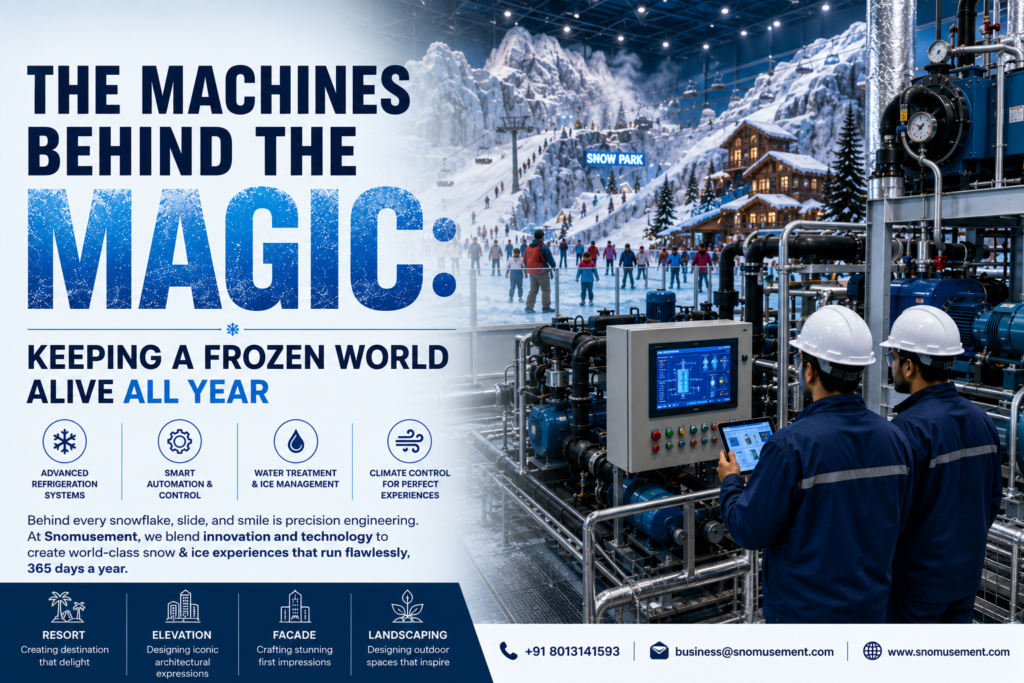
Guests walking into an indoor winter attraction see falling flakes, igloos, and smiling children. What they never see is the invisible machinery working around the clock to hold an entire season hostage inside a building. The difference between a snow park that delights visitors for decades and one that bleeds money within a year is almost never the theme it is the engineering.
Holding minus five in a forty-degree city
The single biggest challenge of operating a snow park in India is the war at the walls. Outside, summer temperatures can cross 40°C; inside, the environment must stay reliably below freezing. Every square metre of the building envelope is a battlefield where heat tries to get in.
Winning that war requires high-performance thermal insulation, vapour barriers that stop moisture from condensing inside walls, and airlock-style entry systems that prevent refrigerated air from escaping every time a guest walks through the door. Poor insulation does not merely raise electricity bills — it creates condensation, ice patches in the wrong places, and structural moisture damage that compounds year after year.
The heart of winter: snow-making systems
Real snow is the product, and producing it indoors is a science. Snow-making machines combine water and compressed air at precise temperatures and humidity levels to create flakes with the right texture — fluffy enough to play in, stable enough to last through the day. Behind them sits an ecosystem of chillers, cold storage, and circulation systems that must be sized correctly from the very first design drawing.
Undersized systems struggle to maintain snow quality during peak weekends. Oversized systems burn capital and energy unnecessarily. This is why feasibility-stage technical evaluation — covering HVAC loads, MEP design, and utility planning is not a formality but the foundation of the entire investment.
Air quality: the detail guests never mention but always feel
Hundreds of guests breathing in a sealed, refrigerated volume creates a less obvious challenge: air management. Fresh air must be introduced and conditioned without disturbing the thermal balance. Humidity must be controlled so that the space feels crisp and alpine rather than damp. When air handling is designed well, guests simply feel invigorated by the “mountain air.” When it is not, they feel clammy, foggy goggles appear, and dwell time quietly collapses.
Designing maintenance into the blueprint
Every machine eventually needs a technician, and every technician needs access. One of the most expensive mistakes in this industry is discovering, after opening, that a chiller cannot be serviced without closing the main attraction. Experienced designers plan service corridors, equipment access routes, and drainage for meltwater into the layout itself, so that maintenance happens invisibly and the guest experience is never interrupted.
Drainage deserves special mention. Snow melts. Meltwater must be collected, drained, and managed continuously, or it refreezes into hazardous ice or seeps into places it should never reach.
Energy: turning the biggest cost into a managed asset
Refrigeration is the largest operating expense of any snow park, which makes energy strategy a design decision, not an afterthought. Zoned cooling that concentrates refrigeration where guests actually play, heat-recovery systems that reuse extracted warmth for water heating or dehumidification, and smart controls that modulate output between peak hours and quiet weekdays can dramatically reduce operating costs. Over a ten-year horizon, these choices often matter more to profitability than the attractions themselves.
Conclusion
The romance of indoor winter is built on an unglamorous foundation of insulation values, refrigeration capacity, and drainage gradients. Get the engineering right, and the magic takes care of itself. At Snomusement Innovations LLP, our turnkey approach integrates climate engineering, safety planning, and immersive design from day one which is how we delivered successful destinations in Raipur and West Bengal with zero safety incidents.
Planning a frozen attraction? Talk to our experts at +91 8013141593 or business@snomusement.com before you finalize a single drawing.