

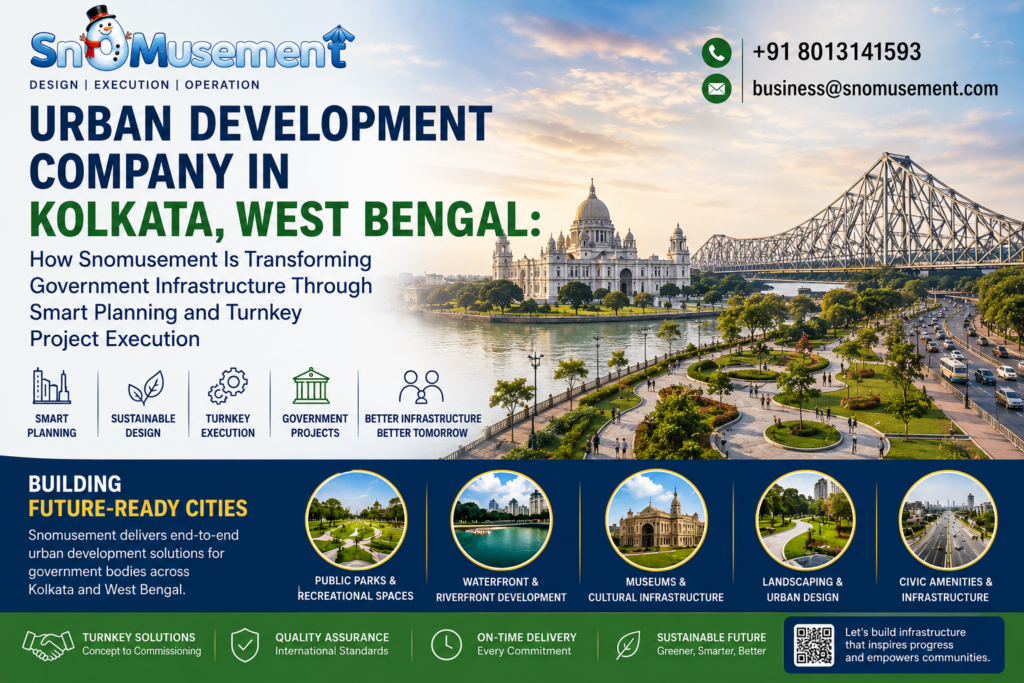
Urban Development in West Bengal Is Entering a New Era
Urban development has become one of the most significant drivers of economic growth, sustainable infrastructure, and public welfare in India. As cities continue to expand and populations grow, governments are increasingly investing in modern infrastructure that improves transportation, tourism, public recreation, environmental sustainability, and community well-being. In this transformation, Kolkata and the wider state of West Bengal are emerging as key hubs for ambitious urban development initiatives.
From smart public parks and tourism infrastructure to integrated recreational facilities, cultural spaces, waterfront development, and civic amenities, government agencies are seeking experienced infrastructure partners capable of delivering projects that combine innovation, functionality, and long-term value.
This growing demand has increased the need for an experienced Urban Development Company in Kolkata that understands government standards, engineering excellence, project management, and sustainable construction practices. Among the companies contributing to this evolving landscape, Snomusement has established itself as a trusted infrastructure development partner by delivering comprehensive turnkey solutions for public-sector and government projects across India.
Rather than focusing solely on conventional construction, Snomusement integrates planning, architecture, engineering, landscape development, tourism infrastructure, entertainment destinations, and public amenities into unified development solutions that create lasting social and economic impact.
Urban development today is no longer limited to building physical structures. It is about shaping experiences, improving accessibility, strengthening civic identity, and creating spaces that serve communities for decades. In a city like Kolkata, where heritage, culture, commerce, and population density intersect, the need for thoughtful and future-ready infrastructure is especially important.
Understanding Urban Development in Today’s India
Urban development extends far beyond constructing roads and buildings. Modern infrastructure planning involves designing environments that improve the quality of life for citizens while supporting economic growth, environmental conservation, tourism, and community engagement.
Today’s urban development projects often include:
- Public parks and recreation areas
- Tourism infrastructure
- Cultural and heritage destinations
- Entertainment districts
- Urban landscaping
- Smart public spaces
- Waterfront development
- Theme-based public attractions
- Museums and interpretation centers
- Eco-tourism facilities
- Sustainable infrastructure
- Civic amenities
- Visitor experience centers
- Public plazas and open spaces
Government departments increasingly seek infrastructure partners capable of managing multiple disciplines under one roof. This integrated approach improves coordination, reduces project delays, minimizes costs, and ensures higher quality standards throughout project execution.
Urban development also plays a critical role in shaping how people interact with their surroundings. Well-designed public spaces encourage social interaction, physical activity, cultural participation, and tourism. They also contribute to environmental resilience by incorporating green cover, water management systems, energy-efficient lighting, and climate-responsive design.
In many cases, urban development projects must balance multiple objectives at once. A single project may need to support tourism, preserve heritage, improve mobility, enhance public safety, and remain financially sustainable. This complexity makes the role of an experienced infrastructure company even more important.
Kolkata: A Growing Hub for Infrastructure and Urban Development
Kolkata has long served as one of India’s most important metropolitan centers. As the capital of West Bengal, the city continues to witness large-scale investment in transportation, tourism, public infrastructure, heritage conservation, commercial development, and recreational facilities.
Several factors contribute to Kolkata’s growing infrastructure demand:
- Expanding urban population
- Tourism development initiatives
- Smart city implementation
- Heritage preservation
- Waterfront redevelopment
- Public park modernization
- Environmental improvement programs
- Recreational infrastructure expansion
- Community-focused civic projects
Government organizations increasingly prioritize projects that create inclusive, sustainable, and visually appealing urban environments capable of serving future generations.
This trend has created opportunities for experienced infrastructure companies that combine technical expertise with innovative planning.
Kolkata’s unique urban character makes development especially challenging and rewarding. The city has a rich architectural legacy, dense neighborhoods, active commercial zones, and a strong cultural identity. Any new infrastructure must therefore be designed with sensitivity to local context, public use patterns, and long-term maintenance requirements.
At the same time, the city is evolving rapidly. Public authorities are looking for solutions that improve livability, attract tourism, support economic activity, and enhance the overall urban experience. This is where a specialized Urban Development Company in Kolkata can make a meaningful difference by delivering projects that are both practical and visionary.
Why Government Infrastructure Projects Require Specialized Expertise
Government projects differ significantly from private developments. They involve extensive planning, regulatory compliance, public accountability, and strict quality requirements.
A successful government infrastructure partner must possess expertise in:
Comprehensive Project Planning
Every government project begins with detailed feasibility studies, site analysis, environmental assessments, budgeting, engineering coordination, and long-term maintenance planning.
Careful planning minimizes execution risks while ensuring public resources are utilized efficiently.
Planning for government infrastructure also requires an understanding of public usage patterns, seasonal demand, accessibility requirements, and future expansion possibilities. A project that appears successful at launch must continue to function effectively years later under changing conditions and increasing footfall.
Engineering Excellence
Government infrastructure demands structural integrity, safety compliance, durability, and adherence to national engineering standards.
Experienced multidisciplinary engineering teams help deliver projects that perform reliably over decades.
Engineering excellence is especially important in projects exposed to heavy public use, weather fluctuations, waterlogging risks, or high visitor volumes. Durable materials, robust foundations, efficient drainage, and maintainable systems are essential for long-term success.
Regulatory Compliance
Public-sector developments require approvals from multiple authorities, environmental clearances, safety certifications, procurement compliance, and detailed documentation.
An experienced infrastructure company understands these regulatory frameworks and manages approvals efficiently.
Compliance is not simply a procedural requirement. It is a critical part of responsible public infrastructure delivery. Delays in approvals can affect timelines, budgets, and public expectations. A company with government project experience can anticipate these requirements and prepare documentation proactively.
Transparent Project Management
Government agencies require detailed reporting, milestone tracking, financial transparency, risk management, and quality assurance throughout every stage of project execution.
Professional project management ensures accountability while minimizing delays.
Transparent communication between stakeholders is essential in public projects. Regular progress updates, clear documentation, and disciplined scheduling help maintain trust and ensure that every phase of the project remains aligned with approved objectives.
Public Safety and Accessibility
Unlike many private developments, government infrastructure must serve diverse user groups, including children, senior citizens, persons with disabilities, tourists, and local residents.
This means every project must consider universal accessibility, safe circulation, emergency response planning, signage, lighting, and barrier-free movement.
Long-Term Maintenance Planning
A successful public project is not only about construction. It must also be easy to operate and maintain over time.
Maintenance-friendly design, durable finishes, efficient utility systems, and practical operational planning help ensure that public assets remain functional and attractive for years.
The Growing Importance of Tourism Infrastructure
Tourism has become one of India’s fastest-growing economic sectors. State governments increasingly invest in tourism infrastructure that attracts visitors, generates employment, and stimulates regional development.
Modern tourism infrastructure includes:
- Destination parks
- Cultural villages
- Heritage interpretation centers
- Museums
- Interactive attractions
- Waterfront promenades
- Landscape enhancement
- Public event spaces
- Entertainment districts
- Eco-tourism facilities
These projects require specialized planning that balances visitor experience, environmental sustainability, operational efficiency, and long-term economic viability.
Snomusement has developed expertise in creating destination-oriented infrastructure that supports tourism growth while meeting government objectives for sustainable development.
Tourism infrastructure must do more than attract visitors. It must create memorable experiences, encourage repeat visits, support local businesses, and reflect the identity of the region. In West Bengal, where culture, history, art, and natural landscapes are deeply intertwined, tourism projects have the potential to become powerful engines of regional development.
Well-executed tourism infrastructure can also help distribute visitor traffic more evenly across districts, reduce pressure on overcrowded urban centers, and create new opportunities for local employment in hospitality, transport, retail, and services.
Smart Public Spaces Are Reshaping Modern Cities
Urban residents increasingly expect public environments that are safe, accessible, aesthetically appealing, and multifunctional.
Today’s smart public spaces integrate:
- Modern landscaping
- Energy-efficient lighting
- Universal accessibility
- Sustainable drainage systems
- Smart irrigation
- Public seating
- Interactive installations
- Digital information systems
- Recreational facilities
- Green infrastructure
These elements contribute to healthier communities while encouraging tourism, recreation, and social interaction.
Infrastructure companies capable of integrating architecture, engineering, landscaping, and technology are becoming valuable partners for government agencies planning next-generation urban spaces.
Smart public spaces are especially important in densely populated cities where open land is limited. By designing parks, plazas, promenades, and civic spaces that are flexible and inclusive, governments can create meaningful public value even within constrained urban footprints.
These spaces also support environmental goals. Trees, shaded walkways, permeable surfaces, rainwater management systems, and native planting strategies can reduce heat, improve air quality, and make cities more resilient to climate challenges.
Integrated Turnkey Development: A Smarter Approach
Traditional construction often involves multiple contractors managing separate aspects of a project. This fragmented approach can lead to communication gaps, cost overruns, and delays.
A turnkey project delivery model streamlines the process by providing a single point of responsibility from concept to completion.
This approach typically includes:
- Master planning
- Concept design
- Detailed engineering
- Architectural services
- Procurement
- Civil construction
- Mechanical, electrical, and plumbing (MEP) works
- Landscape development
- Specialized installations
- Testing and commissioning
- Project handover
- Post-completion support
By managing every phase under one umbrella, companies like Snomusement help government authorities reduce project complexity while maintaining consistent quality standards.
Turnkey execution is particularly valuable for public-sector projects because it simplifies coordination and improves accountability. Instead of managing multiple vendors independently, government agencies can work with one integrated partner responsible for delivering the complete outcome.
This model also improves efficiency in design-to-build transitions. Since planning, engineering, procurement, and execution are aligned from the beginning, the project can move forward with fewer interruptions and fewer opportunities for miscommunication.
Snomusement: Supporting Government Infrastructure with Innovation
Snomusement has built its reputation by delivering integrated infrastructure solutions that combine engineering, creativity, and efficient project execution. The company specializes in planning and developing tourism infrastructure, public recreational spaces, entertainment destinations, museums, landscaped environments, and other urban development projects tailored to government and institutional requirements.
Its multidisciplinary approach enables seamless coordination between architects, engineers, planners, landscape designers, project managers, and technical specialists. This collaborative model helps ensure that every project aligns with functional goals, public expectations, and long-term sustainability objectives.
Whether developing a destination park, upgrading a public recreational area, creating an immersive museum experience, or executing a large-scale civic infrastructure project, Snomusement emphasizes innovation, quality, and timely delivery.
In the next section, we’ll explore Snomusement’s specialized capabilities in government projects, turnkey execution, sustainable design practices, advanced construction technologies, and the unique value it brings to urban development initiatives across Kolkata, West Bengal, and India.
Snomusement’s strength lies in its ability to translate broad development goals into practical, buildable, and visually compelling environments. The company understands that public infrastructure must be both functional and inspiring. It must serve daily users efficiently while also contributing to the identity and pride of the community.
By combining strategic planning with execution discipline, Snomusement helps government bodies move from concept to completion with greater confidence. Its approach is rooted in collaboration, technical precision, and a clear understanding of public-sector expectations.
The Role of Sustainability in Modern Urban Development
Sustainability is now a central requirement in urban development. Government agencies are increasingly prioritizing projects that reduce environmental impact, conserve resources, and support climate resilience.
Sustainable urban development may include:
- Native and low-maintenance landscaping
- Rainwater harvesting systems
- Permeable paving and drainage solutions
- Energy-efficient lighting
- Solar integration
- Waste management planning
- Water conservation systems
- Eco-friendly construction materials
- Reduced heat-island design strategies
- Biodiversity-friendly planting
These measures not only reduce operational costs but also improve the environmental performance of public assets.
For a city like Kolkata, sustainability is especially important due to urban density, seasonal rainfall, and the need to preserve ecological balance while expanding infrastructure. Projects that incorporate green design principles can help cities become healthier, more resilient, and more enjoyable for residents and visitors alike.
Public Infrastructure as a Driver of Social Impact
Urban development is not only about physical transformation. It also has a direct impact on social inclusion, community engagement, and quality of life.
Well-planned public infrastructure can:
- Create safe spaces for families and children
- Improve access to recreation and leisure
- Support cultural participation
- Encourage tourism and local commerce
- Strengthen civic identity
- Promote healthier lifestyles
- Increase public pride in shared spaces
When infrastructure is designed thoughtfully, it becomes a platform for social connection and community development. Parks, plazas, museums, promenades, and civic spaces can all serve as gathering points that bring people together across age groups and backgrounds.
This social dimension is one of the reasons government agencies place such high value on experienced development partners. The success of a public project is measured not only by construction quality but also by how effectively it serves the people who use it.
Why Snomusement Stands Out in the Urban Development Sector
Several qualities distinguish Snomusement as a reliable partner for government infrastructure and urban development projects:
Multidisciplinary Expertise
The company brings together planning, architecture, engineering, landscaping, and project management under one integrated framework.
Government Project Experience
Snomusement understands the documentation, compliance, coordination, and accountability requirements associated with public-sector work.
Turnkey Delivery Capability
From concept development to final handover, the company manages the full project lifecycle with a single-point responsibility model.
Focus on Quality and Timely Execution
Public projects require disciplined scheduling and consistent quality control. Snomusement emphasizes both.
Sustainable and Future-Ready Design
The company incorporates environmentally responsible practices and long-term usability into its development approach.
Destination-Oriented Thinking
Whether the project is a park, museum, tourism site, or civic space, Snomusement designs with user experience and public value in mind.
These strengths make the company a valuable partner for authorities seeking dependable execution and meaningful urban transformation.
Frequently Asked Questions
1. What does an Urban Development Company in Kolkata do?
An Urban Development Company in Kolkata plans, designs, and executes infrastructure projects that improve public spaces, tourism destinations, civic amenities, recreational areas, and other urban environments. These companies often work with government bodies, institutions, and public agencies to deliver projects that are functional, sustainable, and community-focused.
2. Why is Snomusement considered a strong partner for government infrastructure projects?
Snomusement is considered a strong partner because it offers multidisciplinary expertise, turnkey project execution, government project experience, and a strong focus on quality, sustainability, and timely delivery. The company manages projects from concept to completion, which helps reduce complexity for public-sector clients.
3. What types of projects does Snomusement handle?
Snomusement works on a wide range of projects, including public parks, tourism infrastructure, museums, recreational spaces, entertainment destinations, landscaped environments, civic spaces, waterfront developments, and other urban development initiatives for government and institutional clients.
4. What is turnkey project execution in urban development?
Turnkey project execution means one company handles the entire project lifecycle, including planning, design, engineering, procurement, construction, installation, testing, and handover. This approach gives government agencies a single point of responsibility and helps improve coordination, accountability, and efficiency.
5. Why are government infrastructure projects more complex than private projects?
Government infrastructure projects are more complex because they involve regulatory approvals, public accountability, strict quality standards, multiple stakeholders, and long-term maintenance considerations. They must also serve diverse user groups and comply with safety, accessibility, and environmental requirements.
6. How does sustainability influence modern urban development?
Sustainability influences urban development by encouraging the use of eco-friendly materials, energy-efficient systems, water conservation methods, native landscaping, rainwater harvesting, and climate-responsive design. These practices reduce environmental impact and improve the long-term performance of public infrastructure.
7. Why is Kolkata an important city for urban development?
Kolkata is important for urban development because it is a major metropolitan center with a rich cultural heritage, dense population, active tourism potential, and growing infrastructure needs. The city requires thoughtful planning to balance modernization with preservation and public usability.
8. What makes public spaces successful?
Public spaces are successful when they are safe, accessible, attractive, inclusive, and easy to maintain. They should encourage recreation, social interaction, cultural participation, and environmental sustainability while serving the needs of different age groups and communities.
9. How does Snomusement support tourism infrastructure development?
Snomusement supports tourism infrastructure development by creating destination-oriented spaces such as parks, museums, cultural attractions, waterfront promenades, and visitor experience centers. These projects are designed to improve visitor engagement, support local economies, and reflect regional identity.
10. Can Snomusement help with long-term maintenance planning?
Yes, Snomusement considers long-term maintenance during the planning and design stages. The company focuses on durable materials, practical layouts, efficient utility systems, and maintenance-friendly solutions so that public assets remain functional and attractive over time.
11. What role does accessibility play in urban development?
Accessibility is essential in urban development because public infrastructure must serve everyone, including children, senior citizens, tourists, and persons with disabilities. Barrier-free movement, clear signage, safe circulation, and universal design principles help make public spaces inclusive and usable for all.
12. How does urban development contribute to social impact?
Urban development contributes to social impact by creating spaces that improve quality of life, encourage community interaction, support recreation, strengthen civic identity, and promote healthier lifestyles. Well-designed infrastructure can bring people together and create lasting public value.
13. What should businesses look for in a Facade Design Company in India?
A Facade Design Company in India should offer strong design capability, material knowledge, climate-responsive planning, structural coordination, and an understanding of long-term maintenance. Facade design plays an important role in shaping the visual identity, durability, and performance of buildings, especially in commercial and institutional projects.
14. Why are Commercial Elevation Design Services important for modern projects?
Commercial Elevation Design Services are important because they help create attractive, functional, and brand-aligned building exteriors. A well-designed elevation improves first impressions, supports architectural identity, and contributes to the overall value and usability of a commercial or public-facing project.
The Future of Urban Development in Kolkata and West Bengal
The future of urban development in Kolkata and West Bengal will likely be shaped by a combination of smart planning, sustainability, tourism growth, and public infrastructure modernization.
Key trends expected to influence future projects include:
- Greater emphasis on green infrastructure
- Expansion of tourism-linked public spaces
- More inclusive and accessible design
- Integration of digital and interactive features
- Stronger focus on climate resilience
- Increased use of turnkey project delivery
- Public-private collaboration in infrastructure development
As these trends continue to evolve, the demand for experienced urban development partners will only grow stronger.
Companies that can combine technical capability with creative vision and public-sector understanding will play a central role in shaping the next generation of cities and destinations. Snomusement is well positioned within this landscape because of its integrated approach and commitment to delivering infrastructure that serves both present needs and future aspirations.
Conclusion
Urban development in Kolkata, West Bengal, and across India is entering a transformative phase. Governments are no longer looking only for construction contractors; they are seeking strategic partners who can plan, design, and deliver infrastructure that improves lives, supports tourism, strengthens communities, and stands the test of time.
As an experienced Urban Development Company in Kolkata, Snomusement brings together the expertise, innovation, and execution capability needed to support this transformation. Through turnkey project delivery, multidisciplinary coordination, sustainable design, and a strong understanding of government requirements, the company is helping shape public infrastructure that is functional, attractive, and future-ready.
From tourism destinations and public parks to museums, civic spaces, and smart urban environments, Snomusement continues to contribute to the development of spaces that reflect progress, purpose, and public value.
For government agencies and institutions seeking a dependable partner for urban development and infrastructure execution, Snomusement represents a strong combination of vision, capability, and commitment to excellence.