

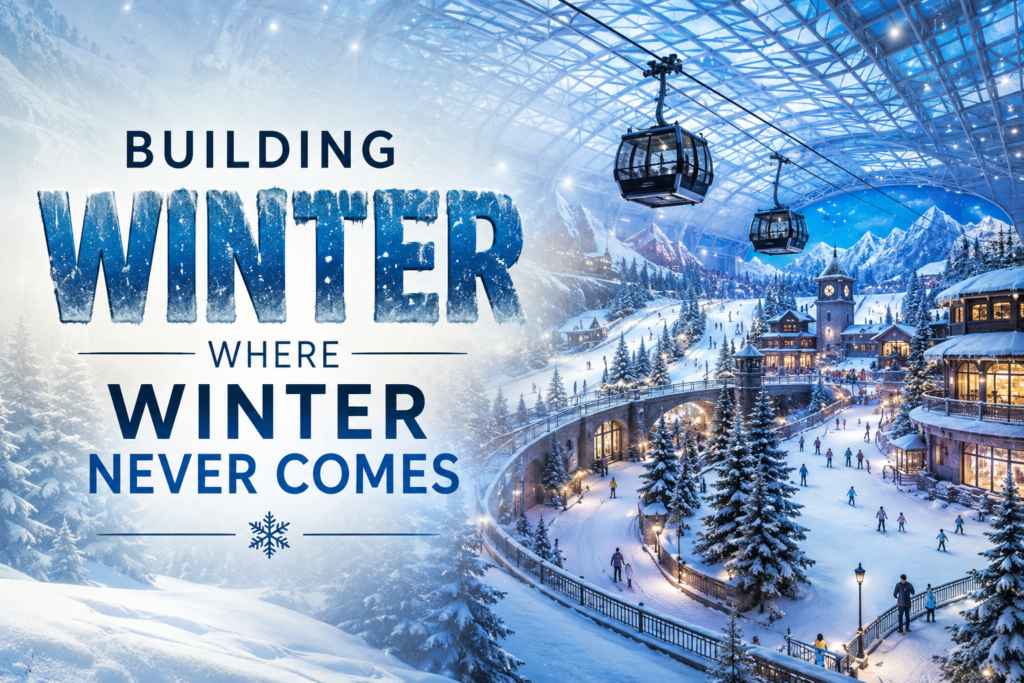
Most Indians have never touched real snow. For a family in Raipur, Kolkata, or Nagpur, a winter holiday to the mountains means expensive travel, crowded hill stations, and unpredictable weather. Now imagine walking ten minutes from your home, stepping through a set of insulated doors, and feeling the temperature drop to minus five degrees — with fresh snow crunching under your shoes.
That is the promise of an indoor snow park, and it is why this format has become one of the most exciting entertainment investments in the country.
The novelty that never wears off
In a tropical country, snow is not just an attraction it is an emotion. Visitors do not come only to slide down slopes; they come to feel cold air on their faces, to throw their first snowball, to watch their children build a snowman in the middle of May. A well-designed snow park converts this deep cultural longing into a repeatable, ticketable experience that works 365 days a year, regardless of the season outside.
Because the novelty is climate-driven rather than trend-driven, demand does not fade the way it does with ordinary amusement formats. The snow parks already operating in India, including those in Raipur and West Bengal, have shown that footfall stays strong long after opening day.
More than a cold room
The mistake many first-time developers make is assuming that a snow park is simply a large refrigerated hall with snow inside. In reality, it is a carefully orchestrated environment where climate engineering, storytelling, and guest psychology must work together.
Thermal zoning keeps the core play area at sub-zero temperatures while creating comfortable transition and acclimatization zones, so guests can warm up, rest, and return to the snow without discomfort. Snow-making systems must produce real, touchable snow with the right texture and moisture balance, day after day. Activity zoning separates gentle snow play for young children from thrill-based slides and snow rides for teens and adults, with clear sightlines so parents can supervise effortlessly.
When these layers are planned as one system, the result feels effortless. When they are not, operators face fogging, icing, energy wastage, and unhappy guests.
Designing for families, not just for photographs
Social media moments matter — an alpine façade, falling snow, and ice-inspired architecture are powerful marketing assets. But the destinations that succeed commercially are the ones designed around families. Warming lounges, hot beverage counters, jacket and boot rental flows, changing areas for children, and comfortable waiting zones all extend dwell time and increase per-capita spending. A guest who stays three hours spends far more than a guest who leaves after forty minutes because the kids got cold.
The business case is frozen solid
From a developer’s perspective, a snow park offers something rare: a premium-priced, weather-proof attraction with limited competition. Ticket pricing can sit well above standard amusement formats, and secondary revenue from rentals, food and beverage, merchandise, and birthday or corporate events adds strong margins. With the right feasibility study and master plan, the model works not only in metros but increasingly in tier-2 cities hungry for landmark attractions.
Conclusion
Bringing winter to a city that has never seen it is one of the most rewarding briefs in the entertainment industry but it demands specialized expertise in climate engineering, safety planning, and experiential design. At Snomusement Innovations LLP, we have successfully delivered snow parks in Raipur and West Bengal, and we manage everything from concept and feasibility to turnkey execution.
Ready to build your city’s first winter? Call us at +91 8013141593 or write to business@snomusement.com for a consultation.